Buick Enclave: Description and Operation
EXHAUST SYSTEM DESCRIPTION
IMPORTANT: Use of non-OEM parts may cause driveability concerns.
The exhaust system is designed to carry exhaust gases away from the engine, route them through emissions-control components, reduce noise, and direct the gases safely toward the rear of the vehicle. In the Buick Enclave, the system works as a complete assembly rather than as a group of separate pipes. Exhaust flow, back pressure, sealing, heat control, vibration isolation, and component alignment all affect how the vehicle performs and how quiet it feels inside the cabin.
After leaving the engine, exhaust gases pass through the catalytic converter where emissions are treated. From there, the gases travel through the exhaust pipe, through a resonator if the vehicle is equipped with one, and into the muffler. The muffler is responsible for reducing exhaust sound so the vehicle maintains a refined and comfortable driving character.
In order to secure the exhaust pipe to the exhaust manifold, a flange and seal-joint coupling is utilized. This type of connection helps maintain a tight seal while allowing the system to be serviced when needed. Depending on the exact configuration, the exhaust system may also use a slip-joint coupling design with a clamp and U-bolt, or a flange connection with a gasket.
Correct sealing at these joints is important. A poor seal can create hissing, ticking, exhaust odor, reduced emissions performance, or incorrect oxygen sensor readings. During service, all sealing surfaces, clamps, gaskets, flanges, and fasteners should be inspected for corrosion, distortion, cracks, or damage before reassembly.
Exhaust hangers and rubber insulators help support the weight of the exhaust pipe while also isolating vibration, rattle, and noise from the vehicle body. These parts are small, but they have a major effect on comfort. A worn or broken hanger can allow the exhaust system to move too much, contact the underbody, or create a dull knocking sound over bumps.
Exhaust hangers also keep the exhaust system properly spaced away from the underbody of the vehicle. This clearance is necessary because the exhaust system expands as it heats up during operation. If the system is installed under tension or too close to the body, heat expansion can cause contact, rattles, stress at the joints, or premature failure of flexible sections and seals.
Exhaust heat shields are used to protect the body, floor panel, wiring, fuel-related components, suspension parts, and other nearby areas from damage caused by exhaust heat. Heat shields also help control heat transfer into the passenger compartment. They should be kept in place and secured correctly, because a missing or loose shield can lead to rattles, excessive heat exposure, or damage to surrounding parts.
Because the exhaust system on the Buick Enclave is exposed to heat, moisture, road salt, vibration, and debris, regular inspection is important. Rust, cracked welds, loose shields, damaged insulators, crushed pipes, and leaking joints can all affect performance, sound quality, emissions operation, and long-term durability.
The exhaust system may be comprised of the following components:
- Exhaust manifold
- Exhaust pipes
- Catalytic converters
- Exhaust muffler
- Exhaust resonator, if equipped
- Exhaust tail pipe, if equipped
- Exhaust hangers
- Exhaust heat shields
Each component has a specific purpose. The manifold collects exhaust gases from the engine, the pipes route those gases through the underbody, the catalytic converters reduce emissions, and the muffler and resonator manage sound. The hangers, insulators, and heat shields support the system and help protect the vehicle from vibration and heat.
Resonator
Some exhaust systems are equipped with a resonator. The resonator may be located either before or after the muffler, depending on system design. Its purpose is to help tune exhaust sound and reduce certain frequencies that could otherwise be heard inside the passenger compartment.
A resonator allows the use of mufflers with less back pressure while still maintaining an acceptable sound level. This is useful when the vehicle requires a balance between exhaust flow, noise control, and overall refinement. Resonators are used when the vehicle’s characteristics require specific exhaust tuning.
If a resonator is damaged, internally loose, or replaced with an incorrect part, the exhaust note may change. The Buick Enclave may develop a drone, hum, buzz, or louder-than-normal tone at certain engine speeds. For this reason, resonator condition and correct part selection matter during exhaust service.
Catalytic Converter
The catalytic converter is an emissions-control device used to reduce hydrocarbons (HC), carbon monoxide (CO), and oxides of nitrogen (NOx) from the exhaust gas. It operates at high temperature and uses a chemical reaction to help convert harmful exhaust pollutants into less harmful emissions before they exit the tailpipe.
The catalytic converter is comprised of a ceramic monolith substrate supported in insulation and housed within a sheet metal shell. The internal substrate contains many small passages that allow exhaust gases to flow through the catalyst surface. This design provides a large reaction area while maintaining controlled exhaust flow.
The substrate may be washcoated with three noble metals:
- Platinum (Pt)
- Palladium (Pd)
- Rhodium (Rh)
These metals help support the chemical reactions needed to reduce emissions. Because the catalyst material is built into the converter, the catalyst inside the catalytic converter is not serviceable. If the converter is restricted, damaged, contaminated, or no longer working correctly, the affected converter assembly must be serviced according to the proper procedure.
Converter condition can be affected by engine misfires, incorrect fuel control, oil or coolant contamination, impact damage, overheating, or exhaust leaks ahead of the converter. When replacing a catalytic converter on the Buick Enclave, the cause of the failure should be considered so the new part is not damaged by an unresolved engine or exhaust condition.
Muffler
The exhaust muffler reduces engine exhaust noise by using internal chambers and tuning tubes. These passages change the way exhaust sound waves move through the muffler, lowering the sound levels created by combustion before the gases leave the exhaust outlet.
A properly functioning muffler helps keep the vehicle quiet and comfortable during idle, acceleration, cruising, and deceleration. If the muffler is damaged internally, rusted through, separated at a seam, or contacting the body, the vehicle may develop a loud exhaust note, rattle, drone, or vibration.
During inspection, the muffler should be checked for corrosion, cracks, loose internal baffles, damaged hangers, and proper clearance from the body. Correct alignment is important because the muffler must be supported securely while still allowing normal exhaust movement and thermal expansion.
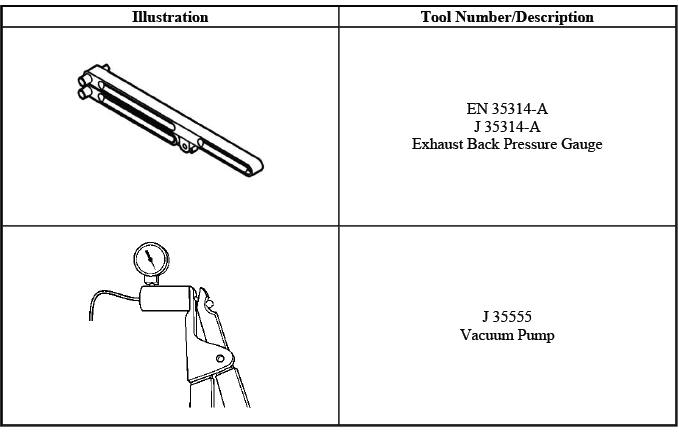
SPECIAL TOOLS AND EQUIPMENT
SPECIAL TOOLS
Special tools may be required to diagnose, measure, remove, or install certain exhaust system components correctly. Using the proper tool helps prevent damage to sensors, flanges, fasteners, seals, and exhaust pipes. It also supports accurate diagnosis when checking for restriction, leakage, or abnormal exhaust noise.
When servicing the Buick Enclave exhaust system, always follow the correct tool recommendations and service procedures. Improvised tools or incorrect methods can lead to damaged threads, distorted flanges, broken fasteners, inaccurate test results, or repeated exhaust leaks after repair.