
Buick Enclave: Specifications, Repair Instructions
SPECIFICATIONS
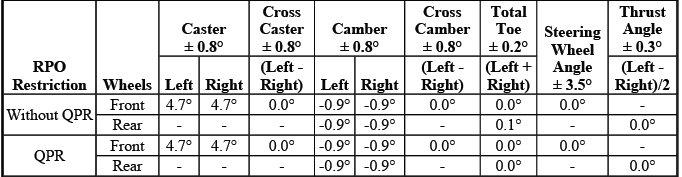
WHEEL ALIGNMENT SPECIFICATIONS
Alignment Condition: Full tank of fuel, no passengers and placed on flat level surface.
Wheel alignment readings must be taken with the vehicle prepared exactly as specified. Fuel level, passenger load, cargo weight, tire pressure, trim height, and the surface under the vehicle can all influence the final readings. On the Buick Enclave, using the correct alignment condition helps prevent false camber, caster, or toe measurements that could lead to unnecessary adjustment.
Wheel Alignment Specifications
FASTENER TIGHTENING SPECIFICATIONS
Fastener Tightening Specifications
Fastener tightening specifications must be followed after any alignment-related adjustment. Suspension cams, tie rod jam nuts, strut fasteners, and related hardware must be tightened to the required value so the alignment setting does not shift after the vehicle is driven. Always use a calibrated torque wrench and avoid relying on impact tool feel.

REPAIR INSTRUCTIONS
WHEEL ALIGNMENT MEASUREMENT
Steering and vibration complaints are not always the result of improper alignment. One possible cause is wheel and tire imbalance. Another possibility is tire lead due to worn or improperly manufactured tires. Lead/pull is defined as follows: At a constant highway speed on a typical straight road, lead/pull is the amount of effort required at the steering wheel to maintain the vehicle's straight path. Lead is the vehicle deviation from a straight path on a level road without pressure on the steering wheel. Refer to Radial Tire Lead/Pull Correction in order to determine if the vehicle has a tire lead problem.
A good alignment diagnosis starts by separating true alignment error from tire, wheel, brake, steering, or suspension faults. A vehicle can pull because of radial tire lead, brake drag, road crown, uneven tire pressure, bent suspension parts, worn bushings, or loose steering linkage. Before changing alignment angles, verify the complaint during a controlled road test and inspect the vehicle for mechanical conditions that could imitate an alignment problem.
Before performing any adjustment affecting wheel alignment, perform the following inspections in order to ensure correct alignment readings:
- Inspect for visible damage to the suspension components and replace as necessary.
- Inspect the tires for the proper inflation and irregular tire wear. Refer to Vehicle Certification, Tire Placard, Anti-Theft and Service Parts ID Label and Tire Diagnosis - Irregular or Premature Wear.
- Inspect the runout of the wheels and the tires. Refer to Tire and Wheel Runout Specifications.
- Inspect the wheel bearings for backlash and excessive play. Refer to Wheel Bearings Diagnosis.
- Inspect the ball joints for looseness or wear.
- Inspect the tie rod ends for looseness or wear.
- Inspect the control arms and stabilizer shaft for looseness or wear.
- Inspect the steering gear for looseness at the frame. Refer to Fastener Tightening Specifications.
- Inspect the struts/shock absorbers for wear, leaks and any noticeable noises. Refer to Suspension Strut and Shock Absorber Testing - On Vehicle.
- Inspect the vehicle trim height. Refer to Trim Height Inspection.
- Inspect the steering wheel for excessive drag or poor return due to stiff or rusted linkage or suspension components.
- Inspect the fuel level. The fuel tank should be full or the vehicle should have a compensating load added.
Each inspection step protects the accuracy of the alignment results. A loose ball joint, worn tie rod, damaged wheel bearing, bent wheel, low tire, or incorrect trim height can cause the alignment machine to show a reading that may change again as soon as the vehicle is driven. Correct these mechanical issues before final adjustment so the Buick Enclave holds the measured settings after service.
Give consideration to excess loads, such as tool boxes, sample cases, etc. If normally carried in the vehicle, these items should remain in the vehicle during alignment adjustments. Give consideration also to the condition of the equipment being used for the alignment. Follow the equipment manufacturer's instructions.
Vehicle loading changes ride height and suspension position. If the vehicle normally carries equipment or cargo, leaving that load in place during alignment may provide a more realistic setting for actual driving use. Alignment equipment must also be calibrated and installed correctly, because poor target placement or an unlevel rack can create inaccurate results.
Satisfactory vehicle operation may occur over a wide range of alignment settings. However, if the setting exceeds the service allowable specifications, correct the alignment to the service preferred specifications. Refer to Wheel Alignment Specifications.
The service preferred specifications should be treated as the target whenever adjustment is required. A reading that is barely within the allowable range may still contribute to tire wear or steering pull if the opposite side is near the other limit. Balance the readings side to side where possible while staying within the specified range.
Perform the following steps in order to measure the front and rear alignment angles:
1. Install the alignment equipment according to the manufacturer's instructions. Make sure each target or sensor is seated correctly and the wheel clamps are not mounted on damaged rim areas.
2. Jounce the front and the rear bumpers 3 times prior to checking the wheel alignment. This settles the suspension bushings, springs, and dampers so the readings reflect a normal ride position.
3. Measure the alignment angles and record the readings. Keep the before-measurements for comparison after adjustment and for documenting the repair.
4. Adjust alignment angles to vehicle specification, if necessary. Refer to Wheel Alignment Specifications. Adjust only after the preliminary inspections confirm that the chassis, tires, and steering components are in serviceable condition.
NOTE:
- Record the "Before" and "After" alignment measurements.
- When performing adjustments to vehicles requiring a 4-wheel alignment, set the rear toe adjustment first in order to obtain proper front alignment angles.
Rear toe can influence the thrust angle and steering wheel position, so it should be corrected before final front toe adjustment. Recording both before and after readings also makes it easier to confirm whether the repair corrected the original complaint.
FRONT CAMBER ADJUSTMENT
Front camber adjustment changes the inward or outward tilt of the front wheel. Incorrect camber can contribute to tire shoulder wear, steering pull, and uneven handling. On the Buick Enclave, this procedure should be performed only after confirming that the strut, steering knuckle, lower control arm, ball joint, wheel bearing, and tire are not damaged.
1. Raise and support the vehicle. Refer to Lifting and Jacking the Vehicle. Support the vehicle securely before removing the tire and wheel assembly.
2. Remove the tire and wheel. Refer to Tire and Wheel Removal and Installation. Inspect the wheel mounting surface and tire wear pattern while the assembly is off.
3. Remove the strut lower bolt in order to inspect for an oblong strut lower hole (3). If the strut lower hole is oblong, loosen the strut upper bolt in order to allow for camber adjustment.
Fig. 1: Adjusting Front Camber
If the strut lower hole is NOT oblong, perform the following steps:
- Remove the upper strut bolt and separate lower part of the strut from the steering knuckle.
- File the strut lower hole laterally (3) in order to allow for camber adjustment.
- Move the strut back in to position with the steering knuckle.
File only the required area and keep the surface controlled so the adjustment slot remains clean and predictable. Remove burrs before reassembly, and make sure the strut and knuckle seat flat against each other before tightening.
4. Install the strut bolts, but do not fully tighten them. Leaving the bolts slightly loose allows the camber angle to be moved into specification.
5. Adjust the camber and tighten the strut nuts. Hold the strut and knuckle in the desired position while tightening so the setting does not shift.
CAUTION: Refer to Fastener Caution.
Tighten
- Tighten the strut lower nuts to 195 N.m (144 lb ft).
After tightening, recheck the camber reading because the angle can move slightly as clamp load is applied. Readjust if the final value is outside specification.
6. Install the tire and wheel. Refer to Tire and Wheel Removal and Installation. Tighten the wheel fasteners evenly to the required specification.
7. Lower the vehicle. Jounce the suspension and remeasure the alignment before completing the repair.
WHEEL ALIGNMENT - STEERING WHEEL ANGLE AND/OR FRONT TOE ADJUSTMENT
Front toe and steering wheel angle must be adjusted together. If front toe is changed unevenly from side to side, the steering wheel may be off-center even when total toe appears correct. Begin with the steering wheel centered and the road wheels pointed straight ahead.
1. Remove the power steering gear seal small clamps. This allows the seal or boot to move without twisting during tie rod adjustment.
2. Verify that the steering wheel is centered and the wheels are in the straight ahead position. Lock or hold the steering wheel as required by the alignment equipment procedure.
3. Loosen the left and right tie rod jam nuts (2). Apply force carefully so the tie rod end, boot, and steering gear seal are not damaged.
Fig. 2: Identifying Tie Rod & Jam Nut
4. Rotate the inner tie rods in order to obtain the proper toe angle of 0º. Make small, even adjustments and watch both total toe and steering wheel angle.
NOTE: Verify that the number of threads showing on both inner tie rod ends are approximately equal.
Keeping the exposed threads approximately equal helps preserve steering gear centering and prevents one tie rod from carrying an excessive adjustment difference. If the thread count is noticeably uneven, inspect for previous repair errors, bent linkage, or incorrect steering wheel centering.
5. Tighten the tie rod end jam nuts.
CAUTION: Use the correct fastener in the correct location. Replacement fasteners must be the correct part number for that application.
Fasteners requiring replacement or fasteners requiring the use of thread locking compound or sealant are identified in the service procedure. Do not use paints, lubricants or corrosion inhibitors on fasteners or fastener joint surfaces unless specified. These coatings affect fastener torque and joint clamping force and may damage the fastener. Use the correct tightening sequence and specifications when installing fasteners in order to avoid damage to parts and systems.
Tighten
- Tighten the left and right tie rod jam nuts (2) to 75 N.m (55 lb ft).
After tightening the jam nuts, recheck toe and steering wheel angle. Tie rod movement during tightening can change the final reading, especially if the tie rod is not held securely.
6. Install the power steering gear seal small clamps.
NOTE: Verify that the power steering gear seal is not twisted.
A twisted steering gear seal can shorten boot life and may allow contamination into the steering linkage area. Make sure the boot is relaxed through the full steering range before the vehicle is released.
REAR CAMBER ADJUSTMENT
Rear camber adjustment changes the rear wheel tilt and can affect tire wear, straight-line stability, and rear suspension tracking. Rear settings should be made carefully because they can also influence the front alignment results through thrust angle and vehicle tracking behavior.
1. Loosen the adjuster cam nut (1). Loosen it only enough to allow cam movement while keeping the adjuster controlled.
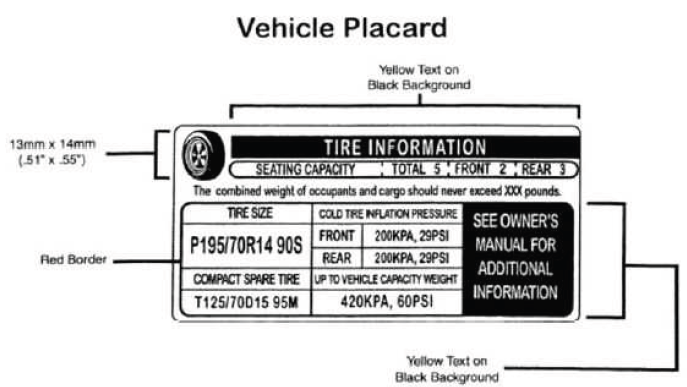
Fig. 3: Identifying Adjuster Cam Nut
2. Using a wrench to rotate the adjuster bolt (2), adjust the cam (3) to specifications. Make small changes and allow the alignment equipment to stabilize after each movement.
3. Using a wrench to hold the adjuster bolt (2), tighten the adjuster nut (1). Holding the bolt prevents the cam from rotating while the nut is tightened.
NOTE: Ensure that the camber settings have not changed after torquing the adjuster nut to specifications. Readjust if necessary.
CAUTION: Refer to Fastener Caution.
Tighten
- Tighten the nut to 140 N.m (103 lb ft).
Final torque can shift the cam slightly, so the reading must be checked after tightening. On Buick Enclave rear suspension service, this recheck is important because a small rear camber change can show up later as inner or outer tire wear.
4. Check the toe alignment and adjust if required. Refer to Rear Toe Adjustment. Rear toe should be verified after camber work because cam movement can influence the toe reading.
5. Test drive the vehicle. Confirm that the vehicle tracks straight, the steering wheel is centered, and no abnormal handling or tire noise is present.
REAR TOE ADJUSTMENT
Rear toe adjustment controls the direction the rear wheels point relative to the vehicle centerline. Incorrect rear toe can cause tire feathering, dog-tracking, steering wheel off-center complaints, or a pull that feels like a front alignment issue.
1. Loosen the adjuster nut (1). Keep the adjuster bolt controlled so the cam does not move unexpectedly.
Fig. 4: Identifying Toe Adjuster Nut
NOTE: Make any adjustments to camber before setting toe.
NOTE: Left side toe adjustment is shown, right side toe adjustment is similar.
2. Using a wrench to rotate the adjuster bolt (2), adjust the cam (3) to specifications. Watch the toe reading closely and avoid large cam movements that can overshoot the target.
3. Using a wrench to hold the adjuster bolt (2), tighten the adjuster nut (1). Hold the adjuster in position until the nut is fully torqued.
NOTE: Ensure that the toe settings have not changed after torquing the adjuster nut to specifications. Readjust if necessary.
CAUTION: Refer to Fastener Caution.
Tighten
- Tighten the nut to 140 N.m (103 lb ft).
After tightening, compare rear toe, total toe, and thrust angle. If the rear toe changed during torque application, loosen the adjuster and repeat the setting process rather than leaving the reading near the edge of specification.
4. Check the toe alignment and adjust if required. Refer to Rear Toe Adjustment. Once rear toe is correct, verify the front toe and steering wheel angle before completing the alignment.
5. Test drive the vehicle. The final road test should confirm stable tracking, proper steering return, a centered steering wheel, and no vibration or pull. If the Buick Enclave still pulls after the alignment is within specification, continue diagnosis for tire lead, brake drag, wheel runout, suspension wear, or road crown influence.
