
Buick Enclave: Description and Operation
CAMBER DESCRIPTION
Camber is one of the main wheel alignment angles used to describe how the tire stands in relation to the road surface. It affects tire contact, steering response, straight-line tracking, and the way the tread wears over time. On the Buick Enclave, camber should be evaluated with the vehicle at the correct trim height and with the suspension, tires, wheels, and wheel bearings in good condition.
Fig. 5: Illustrating Camber Angle
Camber is the tilting of the wheels from the vertical when viewed from the front of the vehicle. When the wheels tilt outward at the top, the camber is positive (+). When the wheel tilts inward at the top, the camber is negative (-). The amount of tilt is measured in degrees from the vertical. Camber settings influence the directional control and the tire wear.
Too much positive camber will result in premature wear on the outside of the tire and cause excessive wear on the suspension parts.
Too much negative camber will result in premature wear on the inside of the tire and cause excessive wear on the suspension parts.
Unequal side-to-side camber of 1º or more will cause the vehicle to pull or lead to the side with the most positive camber.
Cross Camber is the difference between the left camber value and the right camber value.
Cross Camber = L camber - R camber
When diagnosing camber concerns, inspect for bent struts, damaged steering knuckles, worn control arm bushings, loose ball joints, shifted subframe position, incorrect ride height, and impact damage before adjusting alignment. A camber reading that is outside specification is often a symptom of a mechanical condition, especially after curb impact, pothole damage, or previous suspension repair.
CASTER DESCRIPTION
Caster describes the forward or rearward angle of the steering axis when viewed from the side of the vehicle. It does not normally wear the tire in the same direct way as toe or camber, but it has a strong effect on straight-line stability, steering return, and how centered the vehicle feels at highway speed.
Fig. 6: Illustrating Caster Angle
Caster is the tilting of the uppermost point of the steering axis either forward or backward, when viewed from the side of the vehicle. A backward tilt is positive (+) and a forward tilt is negative (-). Caster influences directional control of the steering but does not affect the tire wear. Caster is affected by the vehicle height, therefore it is important to keep the body at its designed height. Overloading the vehicle or a weak or sagging rear spring will affect caster. When the rear of the vehicle is lower than its designated trim height, the front suspension moves to a more positive caster. If the rear of the vehicle is higher than its designated trim height, the front suspension moves to a less positive caster.
With too little positive caster, steering may be touchy at high speed and wheel returnability may be diminished when coming out of a turn. If one wheel has more positive caster than the other, that wheel will pull toward the center of the vehicle. This condition will cause the vehicle to pull or lead to the side with the least amount of positive caster.
Cross Caster is the difference between the left caster value and the right caster value.
Cross caster = L caster - R caster
Because caster is affected by trim height and suspension position, do not judge caster readings until tire pressure, fuel level, cargo load, spring condition, and ride height have been checked. On the Buick Enclave, a rear ride-height change can influence front caster enough to create steering complaints even when no front suspension part has been replaced.
LEAD/PULL DESCRIPTION
At a constant highway speed on a typical straight road, lead/pull is the amount of effort required at the steering wheel to maintain the vehicle's straight path.
IMPORTANT: Vehicles will tend to lead/pull in the direction of the road slope as part of normal operation.
Lead/pull is usually caused by the following factors:
- Road slope
- Variability in tire construction
- Wheel alignment (front cross caster and camber)
- Unbalanced steering gear
- Electronic Power Steering (EPS) steering position and torque sensors not calibrated correctly, if equipped.
A lead or pull complaint should always be verified on a road that is as flat and consistent as possible. Road crown can make a normal vehicle drift slightly, so the technician should compare the response in both directions when safe. Tire construction, brake drag, uneven pressure, and steering sensor calibration can all feel like an alignment concern, which is why a careful road test and tire inspection are needed before changing alignment settings.
SCRUB RADIUS DESCRIPTION
Ideally, the scrub radius is as small as possible. Normally, the SAI angle and the centerline of the tire and the wheel intersect below the road surface, causing a positive scrub radius. With struts, the SAI angle is much larger than the long arm/short arm type of suspension. This allows the SAI angle to intersect the camber angle above the road surface, forming a negative scrub radius. The smaller the scrub radius, the better the directional stability. Installing aftermarket wheels that have additional offset will dramatically increase the scrub radius.
The newly installed wheels may cause the centerline of the tires to move further away from the spindle. This will increase the scrub radius.
A large amount of scrub radius can cause severe shimmy after hitting a bump. Four-wheel drive vehicles with large tires use a steering damper to compensate for an increased scrub radius. Scrub radius is not directly measurable by the conventional methods. Scrub radius is projected geometrically by engineers during the design phase of the suspension.
Scrub radius is one reason wheel offset and tire size should not be changed casually. A wheel that moves the tire centerline outward or inward can change steering leverage, road shock feedback, bearing load, and stability during braking or bumps. For Buick Enclave wheel alignment and wheel replacement work, matching the original wheel offset and tire application helps preserve the steering feel designed into the vehicle.
SETBACK DESCRIPTION
Setback applies to both the front and the rear wheels. Setback is the amount that one wheel may be aligned behind the other wheel. Setback may be the result of a road hazard or a collision. The first clue is a caster difference from side-to-side of more than 1 degree.
Setback can also show up as a steering wheel off-center condition, uneven wheelbase measurement, unusual tracking, or a vehicle that does not respond normally to alignment adjustment. If setback is suspected, inspect the control arms, cradle or subframe position, suspension mounting points, steering knuckle, strut, rear links, and body structure for signs of impact or shifted components.
THRUST ANGLES DESCRIPTION
Thrust angle describes the direction the rear wheels push the vehicle as it moves forward. Even when the front toe is adjusted correctly, an incorrect rear thrust angle can make the vehicle travel slightly sideways, require steering correction, or leave the steering wheel off center.
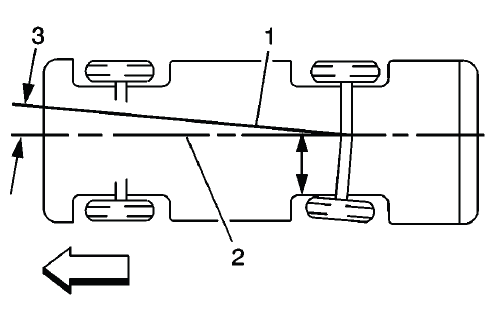
Fig. 7: Illustrating Thrust Angles
The front wheels aim or steer the vehicle. The rear wheels control tracking. This tracking action relates to the thrust angle (3). The thrust angle is the path that the rear wheels take. Ideally, the thrust angle is geometrically aligned with the body centerline (2).
In the illustration, toe-in is shown on the left rear wheel, moving the thrust line (1) off center. The resulting deviation from the centerline is the thrust angle.
If the thrust angle is not set properly the vehicle may "dog track", the steering wheel may not be centered or it could be perceived as a bent axle. Thrust angle can be checked during a wheel alignment.
Positive thrust angle means the thrust line is pointing to the right hand side (RHS) of the vehicle.
Negative thrust angle means the thrust line is pointing to the left hand side (LHS) of the vehicle.
If the thrust angle is out of specification, moving the axle to body relationship will change the thrust angle reading.
If the vehicle is out in the Positive (+) direction-moving the RHS forward and/or LHS rearward will move the thrust angle towards 0º.
If the vehicle is out in the Negative (-) direction-moving the RHS rearward and/or LHS forward will move the thrust angle towards 0º.
When the thrust angle is corrected, the front toe and steering wheel angle should be checked again. Rear toe changes can influence how the vehicle tracks, and a rear alignment issue can easily be mistaken for a front pull complaint. A final road test should confirm that the vehicle travels straight without dog tracking or steering wheel correction.
TOE DESCRIPTION
Toe is one of the most sensitive alignment angles because even a small error can create rapid tire wear. It describes whether the tires point slightly inward or outward compared with the straight-ahead direction of travel.
Fig. 8: Illustrating Toe Angle
Toe is a measurement of how much the front and/or rear wheels are turned in or out from a straight-ahead position. When the wheels are turned in, toe is positive (+). When the wheels are turned out, toe is negative (-).
The actual amount of toe is normally only a fraction of a degree. The purpose of toe is to ensure that the wheels roll parallel.
Toe also offsets the small deflections of the wheel support system that occur when the vehicle is rolling forward. In other words, with the vehicle standing still and the wheels set with toe-in, the wheels tend to roll parallel on the road when the vehicle is moving.
Improper toe adjustment will cause premature tire wear and cause steering instability.
Toe wear often appears as feathered tread edges, a saw-tooth feel across the tread blocks, or rapid wear on both tires of the same axle. On the Buick Enclave, toe should be checked after replacing tie rods, control arms, rear links, struts, steering components, or any part that affects wheel position.
TORQUE STEER DESCRIPTION
Torque steer is a directional pull that appears mainly during acceleration and may reduce or change direction when the throttle is released. It should be separated from a constant lead or pull because the cause is often related to tire diameter, tire pressure, axle angle, engine/transaxle movement, or front suspension geometry under load.
Fig. 9: Identifying Torque Steer
A vehicle pulls or leads in one direction during hard acceleration. A vehicle pulls or leads in the other direction during deceleration.
The following factors may cause torque steer to be more apparent on a particular vehicle:
- A slightly smaller diameter tire on the right front increases a right torque lead. Inspect the front tires for differences in the brand, the construction or the size. If the tires appear to be similar, change the front tires from side-to-side and retest the vehicle. Tire and wheel assemblies have the most significant effect on torque steer correction.
- A large difference in the right and left front tire pressure
- Left-to-right differences in the front view axle angle may cause significant steering pull in a vehicle. The pull will be to the side with the most downward sloping axle from the differential to the wheels. Axles typically slope downward from the differential. The slope of the transaxle pan to level ground may be used as an indication of bias axle angles. The side with the higher transaxle pan (shown on the left side of the illustration) has the most downward sloping axle angle.
When diagnosing torque steer, begin with the tires because tire size, rolling radius, pressure, brand, and construction can make a strong difference. If the complaint changes after swapping front tire and wheel assemblies side to side, the tire assembly is contributing to the condition. If the concern remains, continue with axle angle, engine mount, suspension, and alignment inspection.
WANDER DESCRIPTION
Wander is the undesired drifting or deviation of a vehicle to either side from a straight path with hand pressure on the steering wheel. Wander is a symptom of the vehicle's sensitivity to external disturbances, such as road crown and crosswind and accentuated by poor on-center steering feel.
Wander may be caused by low or uneven tire pressure, worn steering linkage, loose suspension components, excessive toe variation, incorrect caster, tire construction differences, weak shocks or struts, wheel bearing looseness, or an overloaded vehicle. A proper diagnosis should include tire inspection, alignment measurement, steering return check, trim height inspection, and a road test on more than one road surface.
