
Buick Enclave: New Vehicle Break-In. Ignition Positions. Starting the Engine
New Vehicle Break-In
Notice: The vehicle does not require a complicated or highly restrictive break-in procedure. However, the way the vehicle is driven during the first miles can affect long-term smoothness, brake wear, drivetrain response, and overall durability. For the best long-term performance, follow these guidelines carefully during the early operating period:
► If you have all-wheel drive, keep your speed at 88 km/h (55 mph) or less for the first 805 km (500 mi). This helps the drivetrain components settle into normal operation without being exposed to unnecessary high-speed load too early. ► Do not drive at any one constant speed, fast or slow, for the first 805 km (500 mi). Varying vehicle speed gently helps the engine and drivetrain operate through a wider range of normal conditions during the break-in period.Do not make full-throttle starts. Avoid downshifting to brake or slow the vehicle. During the first miles, smooth acceleration and gradual deceleration are better for the Buick Enclave than aggressive launches or harsh speed changes.
► Avoid making hard stops for the first 322 km (200 mi) or so. During this time the new brake linings are not yet fully broken in. Hard stops with new linings can cause premature wear, uneven surface conditioning, and earlier replacement. Follow this break-in guideline every time new brake linings are installed, not only when the vehicle is new. ► Do not tow a trailer during break-in. See Driving Characteristics and Towing Tips for the trailer towing capabilities of your vehicle and more information. Towing places additional load on the engine, transmission, brakes, tires, and cooling system, so it should be avoided until the initial break-in period has passed.Following break-in, engine speed and load can be gradually increased. After the first period of careful driving, the vehicle can be used more normally, but smooth driving habits will still help preserve comfort, performance, and mechanical life.
A thoughtful break-in period is simple but important. The goal is not to drive unusually slowly all the time, but to avoid extremes. Gentle starts, varied speeds, controlled braking, and avoiding heavy loads early can help the Buick Enclave deliver better long-term refinement.
Ignition Positions
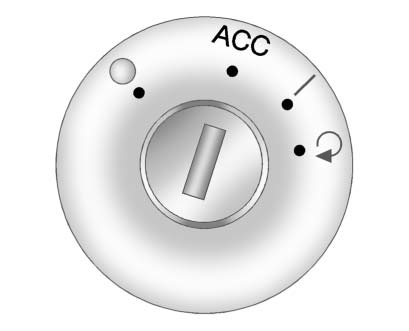
The ignition switch has four different positions. Each position controls a different stage of vehicle operation, from locking the ignition and removing the key to powering accessories, running electrical systems, and starting the engine.
In order to shift out of P (Park), the ignition must be in ON/RUN or ACC/ACCESSORY and the brake pedal must be applied. This helps prevent unintended movement and ensures the driver is actively controlling the vehicle before shifting from Park.
Notice: Using a tool to force the key to turn in the ignition could cause damage to the switch or break the key. Use only the correct key, make sure it is inserted all the way, and turn it only with your hand.
If the key cannot be turned by hand, see your dealer.
Forcing the ignition key can damage internal parts of the ignition cylinder or leave the vehicle unable to start. If the key feels stuck, check that the vehicle is fully in P (Park), the steering wheel is not binding against the lock, and the correct key is being used.
 (STOPPING THE ENGINE/ LOCK/OFF):
When the vehicle is stopped, turn the ignition switch to LOCK/OFF to turn the engine off.
(STOPPING THE ENGINE/ LOCK/OFF):
When the vehicle is stopped, turn the ignition switch to LOCK/OFF to turn the engine off.
Retained Accessory Power (RAP) will remain active. See Retained Accessory Power (RAP). RAP allows certain electrical features to continue operating for a limited time after the engine is turned off, depending on system conditions and door activity.
This position locks the ignition and transmission. The key can be removed in LOCK/OFF. When the key is removed, make sure the vehicle is fully stopped, the transmission is in P (Park), and the parking brake is used when appropriate.
Do not turn the engine off when the vehicle is moving. This will cause a loss of power assist in the brake and steering systems and disable the airbags. Without power assist, the vehicle can become much harder to steer and stop, especially at lower speeds or during emergency maneuvers.
If the vehicle must be shut off in an emergency:
1. Brake using a firm and steady pressure. Do not pump the brakes repeatedly. This may deplete power assist, requiring increased brake pedal force.
2. Shift the vehicle to N (Neutral).
This can be done while the vehicle is moving. After shifting to N (Neutral), firmly apply the brakes and steer the vehicle to a safe location. Keep both hands on the steering wheel and use smooth inputs to maintain control.
3. Come to a complete stop, shift to P (Park), and turn the ignition to LOCK/OFF. On vehicles with an automatic transmission, the shift lever must be in P (Park) to turn the ignition switch to the LOCK/OFF position.
4. Set the parking brake.
See Parking Brake.
 WARNING
Turning off the vehicle while moving may cause loss of power assist in the brake
and steering systems and disable the airbags.
While driving, only shut the vehicle off in an emergency.
If the vehicle cannot be pulled over, and must be shut off while driving, turn the ignition to ACC/ACCESSORY. This should only be done when there is no safer option and the situation requires emergency action.
The steering can bind with the wheels turned off center. If this happens, move the steering wheel from right to left while turning the key to ACC/ACCESSORY. If this does not work, then the vehicle needs service.
ACC (ACC/ACCESSORY): This is the position in which you can operate the electrical accessories or items plugged into the accessory power outlets. This position unlocks the ignition and steering wheel.
Use this position if the vehicle must be pushed or towed. It may also be used when electrical accessories are needed briefly while the engine is not running, but it should not be left on for an extended time because it can discharge the battery.
► (ON/RUN): This position can be used to operate the electrical accessories and to display some instrument panel warning and indicator lights. This position can also be used for service and diagnostics, and to verify the proper operation of the malfunction indicator lamp as may be required for emission inspection purposes.
The switch stays in this position when the engine is running. In normal driving, ON/RUN is the operating position that allows the engine, transmission, electrical systems, warning lights, and control modules to function as designed.
The transmission is also unlocked in this position. If you leave the key in the ACC/ACCESSORY or ON/RUN position with the engine off, the battery could be drained. You may not be able to start the vehicle if the battery is allowed to drain for an extended period of time.
To help protect the battery, avoid leaving the Buick Enclave in an accessory or run position when the engine is not operating. If accessories are needed while parked, use them for short periods and turn the ignition off when finished.
 (START): This is the position that starts the engine. When the engine starts, release the key.
The ignition switch will return to ON/RUN for driving. Do not hold the key in START after the engine is already running, because doing so can place unnecessary strain on the starting system.
Understanding the ignition positions helps prevent battery drain, ignition damage, and unsafe operation. Use LOCK/OFF when the vehicle is parked, ACC/ACCESSORY only when limited electrical power is needed, ON/RUN for normal operation, and START only to crank the engine.
Starting the Engine
Move the shift lever to P (Park) or N (Neutral) before attempting to start the engine. The engine will not start in any other gear position. This safety design helps prevent the vehicle from moving unexpectedly during startup. If the engine must be restarted while the vehicle is already moving, use N (Neutral) only.
Notice: Do not try to shift to P (Park) if the vehicle is moving.
If you do, you could damage the transmission. Shift to P (Park) only when the vehicle is completely stopped.
Before starting the Buick Enclave, make sure the driver's seat, mirrors, and steering wheel are properly adjusted, and confirm that the brake pedal can be pressed comfortably. A calm, controlled starting routine helps protect the transmission, starter system, and engine components.
Starting Procedure
1. With your foot off the accelerator pedal, turn the ignition to START.
When the engine starts, let go of the key. The idle speed will slow down as the engine warms. Do not race the engine immediately after starting it. A cold engine needs a short amount of time for oil to circulate fully and reach all moving parts.
Operate the engine and transmission gently to allow the oil to warm up and lubricate all moving parts. Smooth driving during the first few minutes is especially important in cold weather, after the vehicle has been parked for a long time, or when the engine oil is still thick from low temperatures.
The vehicle has a Computer-Controlled Cranking System. This feature assists in starting the engine and helps protect starting system components. If the ignition key is turned to the START position and then released when the engine begins cranking, the engine will continue cranking for a few seconds or until the vehicle starts. This means the driver does not need to hold the key continuously while the system completes the starting process.
If the engine does not start and the key is held in START, cranking will be stopped after 15 seconds to help prevent cranking motor damage. This protection is important because long, repeated cranking can overheat the starter and drain the battery.
To prevent gear damage, this system also prevents cranking if the engine is already running. Do not turn the key to START after the engine has started, because unnecessary starter engagement can place stress on the starting system.
Engine cranking can be stopped by turning the ignition switch to the ACC/ACCESSORY or LOCK/OFF position. Use this only when needed, such as when the engine does not start normally or when you want to stop the starting attempt.
Notice: Cranking the engine for long periods of time, by returning the key to the START position immediately after cranking has ended, can overheat and damage the cranking motor, and drain the battery. Wait at least 15 seconds between each try, to let the cranking motor cool down.
2. If the engine does not start after five to 10 seconds, especially in very cold weather below 0°F or −18°C, it could be flooded with too much gasoline. Try pushing the accelerator pedal all the way to the floor and holding it there while you hold the key in START for up to a maximum of 15 seconds.
Wait at least 15 seconds between each try to allow the cranking motor to cool down. When the engine starts, let go of the key and accelerator. If the vehicle starts briefly but then stops again, repeat these steps. This clears the extra gasoline from the engine. Do not race the engine immediately after starting it.
Operate the engine and transmission gently until the oil warms up and lubricates all moving parts. After startup, allow the Buick Enclave to settle into a stable idle before placing heavy demand on the engine. Avoid aggressive acceleration until the vehicle begins operating smoothly.
Notice: The engine is designed to work with the electronics in the vehicle. If you add electrical parts or accessories, you could change the way the engine operates. Before adding electrical equipment, check with your dealer. If you do not, the engine might not perform properly. Any resulting damage would not be covered by the vehicle warranty.
Electrical accessories that are not properly installed can affect sensors, control modules, charging performance, or starting behavior. If additional equipment is needed, it should be compatible with the vehicle electrical system and installed correctly.
