
Buick Enclave: Description and Operation
TIRE PRESSURE MONITOR DESCRIPTION AND OPERATION
The tire pressure monitor (TPM) system warns the driver when a significant loss or gain of tire pressure occurs in any of the 4 tires and allows the driver to display the individual tire pressures and their locations on the driver information center (DIC).
On the Buick Enclave, the Tire Pressure Monitoring System is designed to support safer driving by helping the driver recognize tire pressure changes before they lead to poor handling, uneven tire wear, reduced fuel efficiency, or tire damage. The system does not replace routine pressure checks with an accurate gauge, but it provides an important warning when the pressure in one or more tires moves outside the expected range.
The system uses the body control module (BCM), driver information center (DIC), instrument panel cluster (IPC), remote control door lock receiver (RCDLR), a radio frequency (RF) transmitting pressure sensor in each wheel/tire assembly and the serial data circuit to perform the system functions. Each sensor has an internal power supply with a 10 year service life.
Each wheel-mounted sensor is assigned to a specific tire location through the learn procedure. The RCDLR receives the RF messages, identifies the sensor, interprets the pressure information, and passes the data through the vehicle communication network so the IPC and DIC can display warnings or pressure values. Because the sensor battery is built into the sensor assembly, a weak internal power supply usually requires sensor replacement rather than battery service.
When the vehicle is stationary, the sensors internal accelerometer is inactive, which puts the sensors into a stationary state. In this state the sensors sample tire pressure once every 30 seconds and do not transmit at all if the tire pressure does not change. As vehicle speed increases, centrifugal force activates the sensors internal accelerometer causing the sensors to go into rolling mode. In this mode, the sensors sample tire pressure once every 30 seconds and transmit in rolling mode once every 60 seconds. The RCDLR receives and translates the data contained in each sensors RF transmission into sensor presence, sensor mode and tire pressure. The RCDLR sends the tire pressure and tire location data to the DIC via the serial data circuit where they are displayed.
This operating strategy helps preserve sensor battery life while still allowing the system to report useful pressure information during normal driving. When the vehicle is parked, the sensors remain quiet unless a pressure change is detected. Once the Buick Enclave is moving, the sensors wake into rolling mode and begin sending regular updates that allow the receiver to confirm sensor presence and current tire pressure.
The sensors continuously compare their last pressure sample to their current pressure sample and will transmit in re-measure mode if a 8.3 kPa (1.2 psi) change in tire pressure has been detected in either a stationary or rolling state. When the TPM system detects a significant loss or gain of tire pressure, the tire pressure monitor indicator icon is illuminated on the IPC and if equipped, a check tire pressure type message is displayed on the DIC. Both the indicator icon and DIC message can be cleared by adjusting the tire pressures to the recommended kPa/psi and driving the vehicle above 40 km/h (25 mph) for at least 2 minutes.
The re-measure mode allows the system to react to a meaningful pressure change without waiting for the normal rolling transmission interval. This is useful when a tire loses pressure from a puncture, valve leak, bead leak, temperature change, or other pressure-related condition. After the tires are corrected to the placard pressure, the vehicle must be driven long enough for the sensors to transmit updated pressure values and for the RCDLR to confirm that the low or high pressure condition is no longer present.
If power is disconnected from the RCDLR or if the vehicle battery is disconnected each TPM sensor ID is retained but all of the tire pressure information is lost. Under these circumstances the RCDLR cannot assume that the tire pressures were maintained over an unknown period of time. If equipped, the DIC will display all dashes and the scan tool will indicate a default tire pressure value of 1020 kPa (148 psi) for each tire. Driving the vehicle above 40 km/h (25 mph) for at least 2 minutes will activate the sensors causing the DIC to display the current tire pressures. The Tire Pressure Monitor Diagnostic Tool special tool or the pressure increase/decrease method may also be used to activate the sensors as well.
After a battery disconnect or RCDLR power loss, dashes in the DIC do not automatically mean that all four sensors have failed. The receiver still retains the learned sensor IDs, but it needs fresh pressure transmissions before it can display current values. For Buick Enclave service, driving the vehicle above the required speed or activating the sensors with the correct tool is usually enough to restore live pressure data if the sensors and receiver are working normally.
The RCDLR has the ability to detect malfunctions within the TPM system. In the event a DTC is set, the tire pressure monitor indicator icon on the IPC will flash for 1 minute and then remain illuminated after the ignition is turned ON and the IPC bulb check has been completed. Any malfunction detected will cause the DIC to display a service tire monitor system type message. For more information on other functions of the RCDLR, refer to Keyless Entry System Description and Operation.
The warning pattern helps separate a pressure concern from a system fault. A steady tire pressure indicator usually points toward an actual low or high tire pressure condition, while a flashing indicator followed by a steady lamp indicates that a TPM system malfunction has been detected. When a DTC is present, scan tool diagnosis should be used to identify whether the concern is related to a sensor, sensor learn status, RCDLR configuration, RF reception, or module communication.
During diagnosis, always begin with the basics: verify tire pressure with a known accurate gauge, inspect the tire and valve stem for leaks or damage, confirm the correct tire size, and check whether any tire rotation, wheel replacement, flat repair, or sensor service was recently performed. Many TPMS concerns are caused by incorrect pressure, a missed learn procedure, aftermarket wheels, blocked sensor ports from sealant, or sensor damage during tire mounting rather than by a failed receiver.
SPECIAL TOOLS AND EQUIPMENT
SPECIAL TOOLS
The following tools are used to activate sensors, support the learn procedure, and help verify tire pressure monitoring operation. Using the correct tool is important because the sensor must receive the proper activation signal and the technician must confirm that the RCDLR has accepted the sensor ID in the correct wheel position.
EL 46079
Tire Pressure
Monitor Diagnostic
Tool
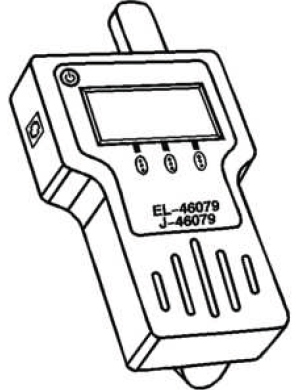
EL 50448
Tire Pressure
Monitor Sensor
Activation Tool
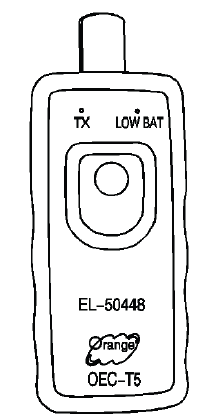
The EL 46079 diagnostic tool and EL 50448 activation tool are used near the valve stem area to trigger sensor transmission during service. If a sensor responds to the tool but the vehicle does not confirm the learn step, reposition the tool, rotate the wheel if needed, and verify that the receiver is in the correct learn mode before replacing parts.
