Buick Enclave: Description and Operation
REAR DRIVE AXLE DESCRIPTION AND OPERATION
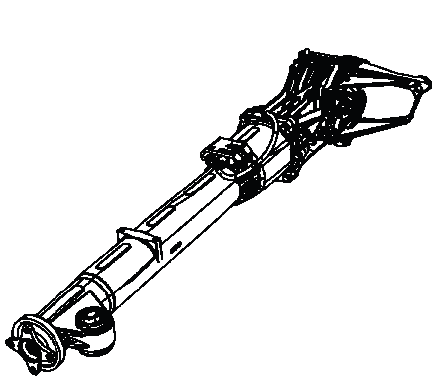
Fig. 51: View Of Rear Drive Axle Assembly
The rear drive axle assembly in this vehicle uses an aluminum housing and, on all wheel drive models, works together with an electric clutch assembly located in the driveline torque tube. The clutch section is separate from the rear drive axle gear section, so the fluids and service concerns must not be treated as one shared system. Differential fluid is contained only in the rear drive axle portion of the rear differential assembly.
For AWD-equipped Buick Enclave models, the clutch assembly is serviced separately from the driveline torque tube assembly. The clutch control module, also called the CCM, is mounted on the torque tube housing and is also serviced as a separate component. This layout allows the rear drive system to control torque transfer electronically while keeping the rear differential gear section mechanically supported and lubricated.
The clutch assembly contains automatic transmission fluid, or ATF. A dedicated seal protects the driveline torque tube from the ATF inside the clutch assembly, while a second seal protects the clutch assembly from gear oil in the rear drive axle section. These seals are important because fluid mixing or leakage can affect clutch response, gear lubrication, and long-term rear axle reliability.
The correct fluid level range for rear drive axle assembly operation is 0.8 to 1.0 liter, depending on housing design and the location of the fill or inspection plug. New service replacement units are shipped dry, without fluid, so they must be filled before operation.
Fill new units with 0.8 liter of GL Synthetic fluid. More importantly, the minimum fluid level should be even with the bottom of the fill hole. If the level is below this point, the rear axle may operate with insufficient lubrication, which can lead to noise, heat, bearing wear, or gear damage.
The driveline torque tube houses the third section of the propeller shaft for packaging purposes only. One bearing is located at each end of the torque tube assembly. These bearings support shaft movement inside the tube and help maintain driveline alignment during vehicle operation.
The rear drive axle system operates as follows:
- The system distributes torque evenly between the 2 rear wheels. This allows both rear wheels to contribute to vehicle movement when rear drive torque is requested.
- The system sends torque to the rear wheels to enhance traction and improve vehicle handling performance. On the Buick Enclave, this rear torque transfer is especially useful during low-traction starts, slippery road conditions, and situations where front wheel slip is detected.
- The rear differential clutch control assembly contains a main clutch, pilot clutch, electromagnetic coil, rear wheel shaft, main cam, and pilot cam. These parts work together to control how much torque is transferred through the rear drive system.
- The clutch control module operates by using a clutch pack to transfer torque. The engagement mechanism uses an electromagnetic coil and armature to modulate torque through a pilot clutch and thrust amplification device. As the commanded current changes, the clutch engagement force changes with it.
- The rear differential has a micro computer which receives information from the clutch control module (CCM). This information helps the system decide how much rear drive torque is needed under changing road and driving conditions.
- The CCM has an internal temperature sensor, which provides continuous temperature compensation for torque transfer from -40ºC to +120ºC. When module temperature is determined to be beyond its limits, the CCM temporarily disables the rear drive system and turns on the AWD Disabled message. When temperature returns within the acceptable range, the CCM enables the rear drive system again. The temperature sensor and coil are internal to the rear differential and are replaced as an assembly.
- If the vehicle is being driven very aggressively and/or an unexpected tire size has been used, the AWD Disabled message may turn on. This condition should not automatically lead to replacement of the CCM module. The tire size, driving conditions, temperature status, and related system data should be checked first.
- The AWD Disabled message will turn on if the mini-spare tire or a very small sized tire has been installed. This should not result in replacement of the CCM module. A tire size mismatch can change wheel speed relationships and make the AWD control system limit rear drive operation as a protective response.
- The clutch coil receives current from the CCM, and that current is used to modulate torque through the engagement mechanism. The greater the current, the greater the torque transfer. The safe current range is between 0.1-3.0 amps. If current moves outside that range, related DTCs may set and the Service AWD message may appear. The temperature sensor and coil are internal to the differential and are replaced as an assembly.
- The module uses vehicle speed, steering angle, wheel slip, thermal compensation, and chassis control intervention to determine current. These values are received as GMLAN messages from other modules. Because the rear axle depends on this shared data, a communication or ABS-related concern can affect AWD operation even when the rear differential hardware is not physically damaged.
- When replacing the CCM, the module must be configured for the clutch control calibrations. The connector on the clutch that plugs into the CCM will have a 2 digit value. Use that 2 digit value to program the CCM using the Tech 2. Entering this value correctly is necessary for proper clutch control and rear drive axle operation.
- Voltage for the module is between 5-24 volts. The system sets a low voltage code, but not a high voltage code, because the module can withstand voltage up to 24 volts. Stable voltage is still important because low voltage can affect control logic, communication, and clutch response.
- The system displays 2 messages in the DIC or IP: Amber AWD Disabled (All Wheel Drive Off) and Service All Wheel Drive. These messages help the driver understand whether AWD operation has been temporarily disabled or whether service diagnosis is required.
In normal operation, the rear drive axle assembly does not run as a permanently locked rear axle. Instead, it uses module-controlled clutch engagement to add rear wheel torque when conditions call for it. The system watches driver input, wheel speed behavior, chassis control activity, and temperature before deciding how much torque should be sent rearward.
For service diagnosis on the Buick Enclave, this means rear axle faults should not be judged from one symptom alone. Tire size, fluid level, connector condition, clutch calibration, DTC history, and scan tool data all matter. A warning message may be caused by overheating, low voltage, a mismatched tire, invalid serial data, or an actual clutch or module fault.
Because the clutch assembly, torque tube, CCM, and rear axle fluid section are related but not identical service areas, each one should be inspected according to its own function. Correct fluid, proper sealing, clean electrical connections, valid calibration, and accurate torque values all help the rear drive axle operate smoothly and quietly.
SPECIAL TOOLS AND EQUIPMENT
SPECIAL TOOLS
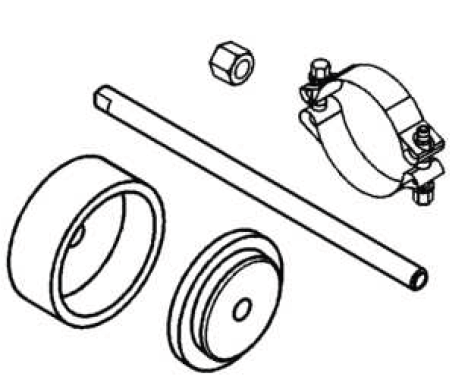
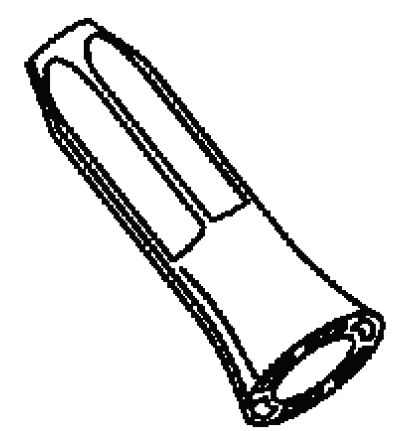
The following special tools are used when servicing seals, bushings, and related rear drive axle components. Using the correct tools helps protect machined surfaces, prevents seal distortion, and keeps bushings aligned during installation. Improvised tools can damage the housing, create leaks, or shorten component life.
J-44636-1
Pinion Seal Installer
J-44809
Seal Installer
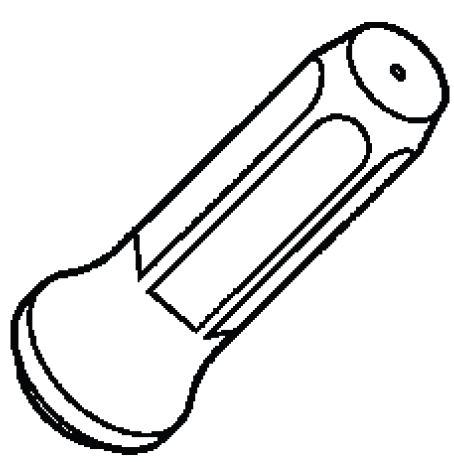
J-45725-A
Frame Bushing
Installer