
Buick Enclave: Description and Operation
ABS DESCRIPTION AND OPERATION
This vehicle is equipped with a Bosch ABS/EBD/TCS/VSES brake system designed to manage braking force, wheel slip, traction, and vehicle stability through a combination of hydraulic control and electronic monitoring. The electronic brake control module (EBCM) and the brake pressure modulator valve are serviced separately, which allows diagnosis and replacement to be handled more accurately when a fault is isolated to one part of the system. The brake pressure modulator valve uses a four-circuit hydraulic layout, allowing pressure at each wheel to be controlled independently during braking and stability events.
On the Buick Enclave, this system does more than prevent wheel lockup. It also helps distribute braking force, support traction control operation, assist stability control corrections, and provide added brake system support under specific driving conditions.
The following vehicle performance enhancement systems are provided.
- Antilock Brake System (ABS)
- Electronic Brake Distribution (EBD)
- Hill Start Assist
- Power Brake Booster Solenoid Vacuum Supply
- Traction Control System (TCS)
- Vehicle Stability Enhancement System (VSES)
Anti-Lock Brake System
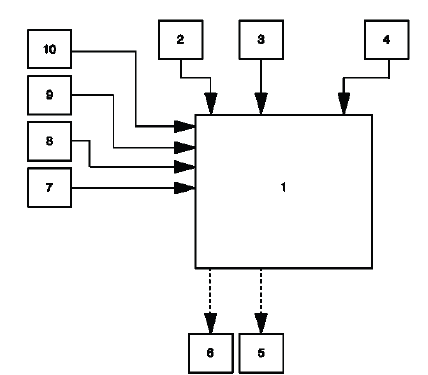
Fig. 38: Anti-Lock Brake System Diagram
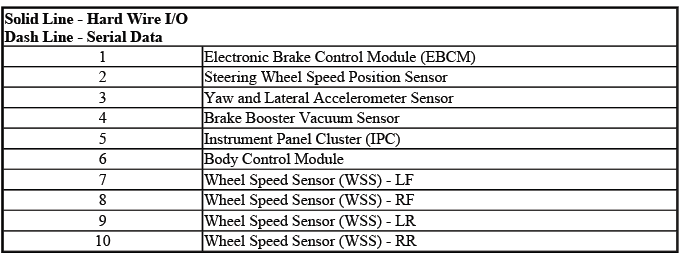
The following components are involved in the operation of the above systems. Each part contributes to the way the vehicle measures wheel movement, brake pressure, steering input, and body motion before the EBCM decides whether hydraulic pressure or engine torque needs to be adjusted.
- ABS pump motor - The ABS pump motor is part of the brake pressure modulator valve. It becomes active during ABS operation, VSES intervention, and base brake power assist functions. When commanded, the pump helps move brake fluid through the modulator so pressure can be reduced, held, or restored as needed during controlled braking events.
- System relays - There are two system relays internal to the EBCM. The solenoid relay is energized when the ignition is ON. The ABS pump motor relay supplies a ground path to the ABS pump motor when the EBCM commands the pump motor on. These relays are built into the module and are not serviced separately.
- Solenoids - The solenoids are commanded ON and OFF by the EBCM to operate the appropriate valves inside the brake pressure modulator valve (BPMV). By opening and closing these valves in a controlled sequence, the system can change hydraulic pressure at individual wheels without affecting all four brakes at the same time.
- Brake booster vacuum sensor - The brake booster vacuum sensor provides input to the EBCM and helps the system determine when the ABS pump motor should operate to precharge the brake system. This information is especially useful when the system needs to maintain consistent brake assist under changing engine vacuum conditions.
- Brake pressure modulator valve (BPMV) - The BPMV uses a 4-circuit configuration to control hydraulic pressure to each wheel independently. This design allows the system to respond to wheel slip at one corner of the vehicle without unnecessarily reducing braking force at the other wheels.
The BPMV contains the following components:
- ABS pump motor and pump
- Four inlet valves
- Four outlet valves
- Two TC isolation valves
- Two TC supply valves
- A master cylinder pressure sensor
- A front low-pressure accumulator
- A rear low-pressure accumulator
- Master cylinder pressure sensor - The master cylinder pressure sensor is located within the brake pressure modulator valve. It uses a 5-volt reference circuit and produces an output signal that changes in proportion to hydraulic fluid pressure in the front brake circuit at the master cylinder. The EBCM uses this signal to understand how much braking force the driver is requesting.
- Steering wheel speed position sensor - The EBCM receives several inputs from the steering wheel position sensor. Three digital square wave signal inputs and one analog signal input are wired directly to the EBCM harness connector. The module uses signals A and B to determine direction and movement, while the analog and index signals help identify the absolute center position. All signals are monitored against each other for plausibility. The sensor receives ground and 5-volt power directly from the EBCM.
- Traction control switch - The vehicle stability enhancement system and the engine torque reduction function of the traction control system can be manually disabled or enabled by pressing the traction control switch. This switch allows the driver to change how much traction assistance is available in certain driving situations.
- Wheel speed sensors (WSS) - The EBCM sends a 12-volt reference voltage signal to each wheel speed sensor.
As each wheel rotates, the wheel speed sensor produces a square wave DC signal voltage. The signal frequency increases as wheel speed increases, but the signal amplitude does not increase. The Buick Enclave uses this wheel speed information to recognize wheel lockup, wheel spin, and differences in rotation between the four wheels.
- Yaw/lateral accelerometer sensor - The yaw rate, lateral acceleration, and longitudinal acceleration sensors are combined into one yaw/lateral accelerometer sensor located outside the EBCM. The control module receives serial data message inputs from this sensor and uses them to support stability control and hill start assist operation. The sensor helps the system understand whether the vehicle is rotating, sliding sideways, accelerating, or decelerating in a way that does not match the driver's steering and braking input.
Anti-Lock Brake System (ABS)
When wheel slip is detected during a brake application, an ABS event occurs. During anti-lock braking, hydraulic pressure in the individual wheel circuits is controlled to help prevent any wheel from locking. A separate hydraulic line and specific solenoid valves are provided for each wheel, which allows the system to decrease, hold, or increase pressure at that wheel as conditions change. ABS does not increase hydraulic pressure above the amount being transmitted by the master cylinder during braking; it only manages the pressure that is already being applied by the driver.
During a hard stop on a slippery or uneven surface, the system compares wheel speed sensor data many times per second. If one wheel begins to slow down too quickly compared with the others, the EBCM can command the BPMV valves to reduce pressure at that wheel, then hold or restore pressure once traction improves. This rapid pressure control helps the driver maintain steering ability while braking.
For the Buick Enclave, correct ABS operation depends on clean wheel speed sensor signals, stable brake pressure information, proper steering position data, and reliable communication between chassis control components. A fault in any of these inputs can affect ABS, traction control, or stability control performance, even when the hydraulic brake system itself appears to operate normally.
During anti-lock braking, the driver may feel a series of fast, repeated pulsations through the brake pedal. These pulsations are created by rapid changes in the position of the individual solenoid valves as the electronic brake control module (EBCM) reacts to wheel speed sensor input and works to prevent wheel slip. This sensation is normal during ABS operation and should not be mistaken for a brake system failure. The pulsations are present only while the system is actively controlling wheel slip, and they stop when regular braking resumes or when the vehicle comes to a complete stop. A ticking, clicking, or popping noise may also be heard as the solenoid valves cycle quickly inside the hydraulic unit. During anti-lock braking on dry pavement, brief tire chirping may occur as the tires approach the point of slip. These sounds and pedal movements are expected characteristics of normal anti-lock brake operation on the Buick Enclave.
Vehicles equipped with ABS can be stopped by applying steady, normal force to the brake pedal. Under normal braking conditions, pedal operation feels similar to a conventional non-ABS brake system. When ABS becomes active, the best braking technique is to maintain firm, constant pressure on the pedal instead of pumping it. Holding steady pedal force allows the system to manage hydraulic pressure at the wheels while helping the driver maintain directional stability and achieve an effective stopping distance. The typical ABS control sequence is described below.
Pressure Hold
Pressure hold occurs when the EBCM detects wheel slip and needs to prevent additional hydraulic pressure from being applied to the affected wheel. The module closes the isolation valve while keeping the dump valve closed. This isolates the slipping wheel circuit and holds the brake pressure at its current level. During this phase, pressure does not increase or decrease; the system pauses pressure change long enough to determine whether the tire can regain traction.
Pressure Decrease
If holding pressure is not enough to correct the wheel slip condition, the system moves into pressure decrease. The EBCM reduces hydraulic pressure to the individual wheel during deceleration by keeping the isolation valve closed and opening the dump valve. Excess brake fluid is directed into the accumulator until the pump can return the fluid to the master cylinder or reservoir. This controlled pressure reduction helps the wheel begin rotating again instead of remaining locked or nearly locked.
Pressure Increase
After the wheel slip condition has been corrected and the tire has regained usable traction, pressure increase occurs. The EBCM opens the isolation valve and closes the dump valve, allowing hydraulic pressure from the master cylinder to be delivered back to the wheel circuit. This increases braking force at that wheel so the vehicle can continue slowing down efficiently. On the Buick Enclave, these pressure hold, decrease, and increase phases can happen very quickly and repeatedly during one ABS stop.
Electronic Brake Distribution (EBD)
Electronic Brake Distribution (EBD) is a control strategy that improves the hydraulic proportioning function normally handled by the mechanical proportioning valve in the base brake system. The EBD function is built into the operating software of the electronic brake control module. Using existing ABS hardware and wheel speed information, EBD actively regulates rear brake pressure so braking force is balanced more effectively between the front and rear wheels. This helps maintain stable braking behavior when vehicle load, road surface, or braking demand changes.
Brake Pressure Application
The EBCM uses brake pressure application to support traction control by transferring torque through the driveline to wheels that still have traction. When a driven wheel begins to slip, the ABS pump motor and the appropriate valve solenoids are commanded ON and OFF to apply brake pressure to the slipping wheel. This brake intervention attempts to bring the driven wheel speed signals closer together, helping reduce uncontrolled wheel spin.
The EBCM does not allow excessive brake pressure application because overheated solenoid coils or overheated brakes can damage components or reduce the driver's ability to stop the vehicle safely. The system is designed to limit brake intervention when heat buildup reaches a calculated threshold.
Estimated solenoid coil and brake temperatures are calculated by the EBCM software. If the solenoid coils become overheated, brake pressure application is disabled and a stability system disabled message may be displayed. If the brakes become overheated, brake pressure application during TCS events is disabled, but VSES can remain functional. As long as engine torque reduction is still enabled, this condition may occur without a driver message and without a DTC being set. This strategy helps protect the brake system while still preserving as much stability control function as possible.
Hill Start Assist
Hill Start Assist helps the driver start moving on an incline without the vehicle rolling backward while the driver's foot moves from the brake pedal to the accelerator pedal. When the EBCM determines that the vehicle is on a grade and the driver intends to move uphill, either forward or backward, it calculates the amount of brake pressure needed to hold the vehicle briefly. The module then commands the appropriate solenoid valves ON and OFF to hold that pressure for a short time after the brake pedal is released. In the Buick Enclave, this feature can make uphill starts smoother and more controlled, especially during low-speed maneuvers or stop-and-go driving on a slope.
The following inputs are used for hill start assist feature:
- Brake switch
- Brake pressure
- Longitudinal acceleration
- Engine torque
- Reverse gear information
- Accelerator pedal position
- Vehicle speed
Vehicle Stability Enhancement System (VSES)
Vehicle Stability Enhancement System (VSES) provides added stability during aggressive maneuvers, sudden steering inputs, or situations where the vehicle's actual path does not match the driver's intended direction. Yaw rate is the rate of rotation around the vehicle's vertical axis. The VSES becomes active when the electronic brake control module determines that the desired yaw rate, calculated from steering and vehicle data, does not match the actual yaw rate measured by the yaw rate sensor.
When this difference is large enough, the system may use selective brake pressure application and engine torque management to help correct the vehicle's path. By applying brake force at specific wheels, the system can help reduce oversteer or understeer and improve directional control. Proper VSES operation depends on accurate wheel speed data, steering position information, brake pressure input, and yaw/lateral acceleration sensor signals working together as one system.
The desired yaw rate is calculated by the EBCM primarily from several key inputs that describe what the driver is asking the vehicle to do and how the vehicle is actually moving.
- The position of the steering wheel
- The speed of the vehicle
- The lateral or sideways acceleration of the vehicle
The difference between the desired yaw rate and the actual yaw rate is known as yaw rate error. This error shows whether the vehicle is beginning to oversteer or understeer. When the EBCM detects a yaw rate error, it attempts to correct the vehicle's rotation by applying brake pressure to one or more wheels. The amount of brake pressure applied depends on how much correction is needed and how quickly the vehicle is moving away from the intended path. If braking correction alone is not enough, engine torque may also be reduced to help slow the vehicle while maintaining stability.
VSES activation usually happens during turns, sudden maneuvers, or aggressive driving conditions where the vehicle begins to rotate differently than expected. When the brakes are applied during VSES activation, the driver may feel pedal pulsation. This pulsation is normal, but it is typically faster and sharper than the pulsation felt during a standard ABS stop. On the Buick Enclave, this difference in pedal feel can help distinguish a stability control event from a basic anti-lock braking event.
Power-Up Self-Test
The electronic brake control module (EBCM) can detect many system malfunctions whenever the ignition is ON. However, some faults cannot be confirmed until the system actively commands certain components to operate.
For example, shorted solenoid coil windings or ABS pump motor winding faults may not be detected until those components are switched ON by the EBCM. Because of this, the system performs a power-up self-test to verify the operation of key electrical and hydraulic control components.
The first phase of the power-up self-test begins when the ignition is turned ON. During this stage, the EBCM performs internal module checks and monitors system sensors, circuits, power feeds, and related inputs for faults that can be detected without vehicle movement.
The second phase of the power-up self-test begins when the vehicle is driven faster than 15 km/h (9 MPH), provided the EBCM has not detected any traction control or vehicle stability-related concerns. This part of the self-test may be heard or felt by the driver. The system solenoids and ABS pump motor are briefly commanded ON and OFF to verify proper operation, and the EBCM also checks that the brake system can return to base braking if a failure occurs. During this test, the module briefly isolates all four wheels by closing the four isolation valves. In some cases, the driver may notice a momentary hard brake pedal. This short sensation is expected and does not mean the brake system has failed.
VSES Sensors Initialization
The vehicle stability enhancement system (VSES) sensor values can vary slightly because of temperature changes, sensor mounting differences, connector resistance, manufacturing tolerances, and normal electrical variation. Since VSES is a sensitive and precise control system, the EBCM must accurately match a sensor voltage to the real physical movement it represents.
For example, the yaw rate signal in one vehicle may read 2.64 volts at +18.0 deg/sec yaw rate, while another vehicle may read 2.64 volts at +17.5 deg/sec yaw rate. Because of these small differences, the EBCM performs an initialization procedure at the beginning of each ignition cycle. During this process, the module observes how the VSES sensors relate to one another and determines what each sensor reads when the measured value should equal zero. This reference value is called the sensor bias voltage.
Although the VSES may still activate before the initialization process is fully completed, the system does not deliver its best performance until all required sensors have been initialized. On the Buick Enclave, accurate sensor initialization is especially important because stability control decisions are based on several inputs working together, not on one sensor alone.
The following VSES sensors require initialization:
- The yaw rate sensor
- The lateral accelerometer sensor
- The longitudinal acceleration sensor
- The master cylinder pressure sensor
- The steering wheel position sensor
When vehicle speed is greater than 25 km/h (15 MPH), full sensor initialization must occur within 3 km (1.8 mi) of driving or within 1 km (0.6 mi) of straight and stable driving, whichever occurs first. Initialization may fail because of driving conditions, such as traveling on a very winding road, making repeated steering corrections, or driving in a way that does not allow the module to establish a stable reference. However, failed initialization is more commonly caused by a sensor bias voltage that is outside the acceptable range.
When initialization fails, a DTC often sets soon afterward. The message center may display a stability system disabled message to alert the driver that the stability control system is not operating at full capability. Before replacing parts, the technician should verify sensor data, connector condition, mounting position, and related calibration status.
ECE 13 Response
The electronic brake control module (EBCM) illuminates the ABS indicator when it detects a malfunction that disables ABS operation. In most cases, the ABS indicator turns OFF during the next ignition cycle if the fault is no longer present. However, wheel speed sensor-related DTCs follow a specific response strategy.
When a wheel speed sensor DTC has been set, the ABS indicator may remain illuminated during the next ignition cycle until the vehicle is driven faster than 13 km/h (8 MPH). This allows the EBCM to confirm that the wheel speed sensor signal has returned to normal before the ABS indicator is turned OFF. This behavior can still occur even if the DTCs were cleared with a scan tool and the indicator initially turned OFF.
When servicing the Buick Enclave, it is important to confirm that the ECE 13 response has completed before returning the vehicle to the customer. The technician should verify that the ABS indicator does not illuminate again after the required vehicle speed has been reached. It is also important to make sure ECE 13 behavior is not being mistaken for a new fault when the ABS indicator is ON but no current DTCs are stored.
A proper final check should include a scan tool review, a short road test above the required speed threshold, and confirmation that ABS, traction control, and stability-related indicators respond normally. This prevents unnecessary diagnosis and helps ensure the brake control system is ready for normal operation.
Driver Information Indicators and Messages
The following indicators and driver information messages are used to alert the driver when the brake, ABS, traction control, or stability control system detects a condition that needs attention. These warnings may appear because of a normal operating state, such as the park brake being applied, or because a control module has detected a fault that affects system operation.
On the Buick Enclave, these messages are not random dashboard warnings. They are usually requested through serial data communication between the body control module, electronic brake control module, instrument panel cluster, and other related modules. Correct diagnosis should always consider both the warning shown to the driver and the module that requested it.
Brake Warning Indicator
The instrument panel cluster (IPC) illuminates the brake warning indicator when one of the following conditions occurs. This indicator should always be treated seriously because it may relate to the base hydraulic brake system, park brake status, brake fluid level, or a condition that also affects electronic brake distribution.
- The body control module (BCM) detects that the park brake is engaged. The IPC receives a serial data message from the BCM requesting illumination. When the park brake is applied, the brake warning indicator flashes at a rate of approximately twice per second to help distinguish this condition from some other brake warnings.
- The electronic brake control module (EBCM) detects a low brake fluid condition or a base brake pressure differential and sends a serial data message to the IPC requesting illumination. In this case, the brake hydraulic system should be inspected before the vehicle is returned to normal operation.
- The IPC performs the bulb check. This is a normal check during startup and confirms that the indicator is capable of illuminating when needed.
- The EBCM detects an ABS-disabling malfunction that also disables electronic brake distribution (EBD) and sends a serial data message to the IPC requesting illumination. Since EBD affects brake force balance, this warning may appear together with other ABS-related indicators.
ABS Indicator
The IPC illuminates the ABS indicator when one of the following conditions occurs. The ABS indicator does not always mean the base brakes have failed, but it does mean that anti-lock brake support may be disabled or limited until the condition is corrected.
- The EBCM detects an ABS-disabling malfunction and sends a serial data message to the IPC requesting illumination. The related DTCs should be checked with a scan tool before replacing any component.
- The IPC performs the bulb check. A brief illumination during startup is normal and does not indicate a fault by itself.
- The IPC detects a loss of serial data communication with the EBCM. If communication is interrupted, the cluster may illuminate the ABS indicator because it can no longer confirm the operating status of the brake control system.
- A DTC is set during the previous ignition cycle which requires an ECE 13 response at the beginning of the current ignition cycle. The EBCM sends a serial data message to the IPC requesting illumination until the required verification condition has been met.
Traction Control Off Indicator
The IPC illuminates the traction off indicator when traction-related assistance has been disabled by the system or intentionally turned off by the driver. On the Buick Enclave, this indicator helps the driver understand when engine torque reduction or stability-related traction support is not operating in the normal automatic mode.
- The EBCM disables engine torque reduction due to a malfunction and sends a serial data message to the IPC requesting illumination. This may occur when the system cannot reliably control wheel slip through powertrain intervention.
- The driver manually disables VSES and engine torque reduction by pressing the traction control switch.
The EBCM sends a serial data message to the IPC requesting illumination. In this case, the indicator is not necessarily showing a failure; it may simply confirm that the driver has selected a reduced traction control mode.
Service Brake Booster Message
The service brake system message is displayed whenever the red brake warning indicator is illuminated. This message should be investigated with the same priority as the warning lamp, because it may be related to brake fluid level, brake pressure, park brake input, or a system condition that affects normal braking assistance.
Stabilitrak Off Message
The message center displays the Stabilitrak off message when one or more of the following conditions exists. This message means that stability control assistance has been turned off, reduced, or disabled because the system has detected a condition that prevents normal operation.
- The transfer case is shifted into 4 LO. The EBCM sends a serial data message to the IPC requesting illumination. This operating mode may change how stability functions are managed.
- The driver manually disables the VSES and engine torque reduction by pressing the traction control switch. The EBCM sends a serial data message to the IPC requesting illumination, confirming that the driver-selected mode has changed the normal stability control strategy.
- The estimated temperature of any solenoid coil exceeds an acceptable limit. The EBCM sends a serial data message to the IPC requesting this display. This protects the hydraulic control components from excessive heat during repeated or demanding brake intervention events.
- The EBCM detects a failed brake switch. The EBCM sends a serial data message to the IPC requesting this display. A DTC sets when this condition exists because brake pedal input is important for ABS, traction control, hill start assist, and stability control decisions.
- VSES sensor initialization time is excessive. The EBCM sends a serial data message to the IPC requesting this display. If the system cannot complete sensor initialization, stability control may not have reliable reference data.
- Serial data communication between the EBCM and any of several other control modules is interrupted.
The EBCM sends a serial data message to the IPC requesting this display, or the IPC displays the message when communication with the EBCM is interrupted. Communication faults should be diagnosed carefully because the displayed message may be the result of missing data rather than a failed stability control component.
- The powertrain control module is not able to perform engine torque reduction. The EBCM sends a GMLAN message to the IPC requesting this display. DTCs set when this condition exists because traction and stability control may need engine torque management to help correct wheel slip or vehicle rotation.
- The EBCM detects an excessively low or excessively high ignition voltage. The EBCM sends a GMLAN message to the IPC requesting this display. Voltage problems can cause misleading brake, ABS, and stability messages, so battery condition, charging system output, and module power feeds should be verified.
Service Stabilitrak Message
The message center displays the service stability system message when any one of many VSES-disabling DTCs is set. The EBCM sends a serial data message to the IPC requesting this display. On the Buick Enclave, this message should be diagnosed by checking current and history DTCs, reviewing sensor data, and confirming that steering angle, yaw rate, wheel speed, brake pressure, and module communication inputs are all plausible.
Service Traction Control Message
The message center displays the service traction control system message when any one of many traction control-disabling DTCs is set. The EBCM sends a serial data message to the IPC requesting this display. This warning may be caused by a wheel speed sensor fault, brake control issue, communication concern, engine torque reduction problem, or another condition that prevents normal traction control operation.
When diagnosing these driver information messages, avoid replacing parts based only on the text shown in the message center. The message identifies the affected function, but the root cause must be confirmed through scan tool data, DTC status, module communication checks, voltage verification, and inspection of the related brake or chassis control circuits. For the Buick Enclave, several brake and stability messages can share the same underlying cause, so a complete diagnostic approach prevents unnecessary repairs.
