
Buick Enclave: Automatic Transmission
The automatic transmission has a shift lever located on the console between the seats. This console-mounted lever allows the driver to select Park, Reverse, Neutral, Drive, and Low depending on the driving situation. Each range is designed for a specific purpose, and using the correct range helps protect the transmission and maintain proper vehicle control.
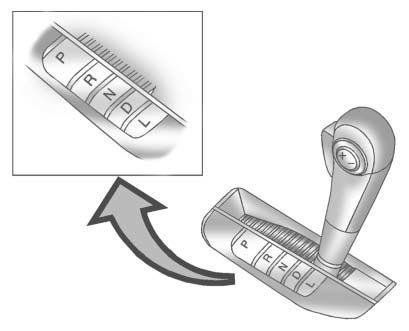
P (Park) should be used whenever starting the engine, parking the vehicle, or preparing to remove the ignition key. Make sure the shift lever is fully seated in the Park position before releasing the brake pedal or leaving the driver seat.
 WARNING
It is dangerous to get out of the vehicle if the shift lever is not fully in
P (Park) with the parking brake firmly set. The vehicle can roll.
Do not leave the vehicle when the engine is running unless you have to. If you have left the engine running, the vehicle can move suddenly. You or others could be injured. To be sure the vehicle will not move, even when you are on fairly level ground, always set the parking brake and move the shift lever to P (Park). See Shifting Into Park . If you are pulling a trailer, see Driving Characteristics and Towing Tips .
Make sure the shift lever is fully in P (Park) before starting the engine. This helps prevent unexpected movement and allows the starting system to operate as intended.
The vehicle has an automatic transmission shift lock control system. You must fully apply the regular brake first and then press the shift lever button before shifting from P (Park) when the ignition key is in ON/RUN. This feature is designed to reduce the chance of accidental movement from Park.
If you cannot shift out of P (Park), ease pressure on the shift lever, then push the shift lever all the way into P (Park) as you maintain brake application. This may help if the lever is not fully seated or if pressure from the vehicle weight is holding the parking mechanism.
Then press the shift lever button and move the shift lever into another gear. See Shifting out of Park . If the Buick Enclave still does not shift out of Park normally, avoid using excessive force and have the condition checked.
► (Reverse): Use this gear to back up.Before shifting to R (Reverse), bring the vehicle to a complete stop and check the area behind the vehicle. Use mirrors, look over your shoulder when appropriate, and back up slowly. Reverse should only be used for controlled backward movement.
Notice: Shifting to R (Reverse) while the vehicle is moving forward could damage the transmission. The repairs would not be covered by the vehicle warranty. Shift to R (Reverse) only after the vehicle is stopped.
To rock the vehicle back and forth to get out of snow, ice, or sand without damaging the transmission, see If the Vehicle Is Stuck . When rocking the vehicle, shift carefully and allow the wheels to stop before changing direction.
► (Neutral): In this position, the engine does not connect with the wheels. To restart the engine when the vehicle is already moving, use N (Neutral) only. Also, use N (Neutral) when the vehicle is being towed.N (Neutral) can be useful in specific situations, such as restarting the engine while moving or preparing the vehicle for certain towing procedures. It should not be used as a normal driving range. When the vehicle is in Neutral, it can roll freely if the brake pedal is not applied.
WARNING
Shifting into a drive gear while the engine is running at high speed is dangerous.
Unless your foot is firmly on the brake pedal, the vehicle could move very rapidly.
You could lose control and hit people or objects. Do not shift into a drive gear while the engine is running at high speed.
Notice: Shifting out of P (Park) or N (Neutral) with the engine running at high speed may damage the transmission.
The repairs would not be covered by the vehicle warranty. Be sure the engine is not running at high speed when shifting the vehicle.
Always let the engine return to a normal idle before shifting into a drive gear. Keeping your foot firmly on the brake pedal while shifting helps prevent sudden movement and gives the driver better control.
► (Drive): This position is for normal driving. It provides the best fuel economy. If you need more power for passing, and you are: ► Going less than 56 km/h (35 mph), push the accelerator pedal about halfway down.► Going about 56 km/h (35 mph) or more, push the accelerator all the way down.
D (Drive) is the main driving range for most road conditions. It allows the transmission to shift automatically through the proper gears for acceleration, cruising, and fuel efficiency. For everyday driving in the Buick Enclave, Drive is the correct choice for city streets, highways, and normal traffic situations.
When additional power is needed, such as when passing another vehicle or merging onto a highway, pressing the accelerator farther down signals the transmission to select a lower gear if needed. This provides stronger acceleration while keeping the transmission operation automatic.
Notice: If the vehicle seems to accelerate slowly or not shift gears when you go faster, and you continue to drive the vehicle that way, you could damage the transmission. Have the vehicle serviced right away. You can drive in L (Low) when you are driving less than 56 km/h (35 mph) and D (Drive) for higher speeds until then.
If the vehicle does not shift normally, feels sluggish, slips, or fails to respond as expected, have it inspected promptly. Continuing to drive with a transmission concern can make the damage worse and may lead to more expensive repairs.
If the vehicle is stopped on a hill, with your foot off the brake pedal, the vehicle may roll. This is normal and is due to the torque converter designed to improve fuel economy and performance. Use the brake to hold the vehicle on a hill. Do not use the accelerator pedal.
Holding the vehicle on a hill with the accelerator can create unnecessary heat and strain in the transmission. Use the brake pedal instead, then accelerate smoothly when it is time to move.
► (Low): This position gives you access to gear ranges.This provides more engine braking but lower fuel economy than D (Drive). You can use it on very steep hills, or in deep snow or mud.
L (Low) can help the driver maintain better control at lower speeds when extra engine braking or stronger low-speed response is needed. It may be useful when descending steep grades, driving through deep snow, moving through mud, or traveling in conditions where frequent gear changes are not desired.
Use Low carefully and only when the driving situation calls for it. Returning to D (Drive) when normal road conditions resume helps the Buick Enclave operate more efficiently and smoothly.
