
Buick Enclave: Tire Sidewall Labeling. Tire Designations. Tire Terminology and Definitions
Tire Sidewall Labeling
Useful information about a tire is molded into its sidewall. This information helps identify the tire size, load rating, construction type, manufacturing details, performance grades, and special-use limitations.
The examples show a typical passenger vehicle tire and a compact spare tire sidewall. Reading the tire sidewall correctly is important when replacing tires, checking specifications, or confirming that a tire is suitable for the vehicle.
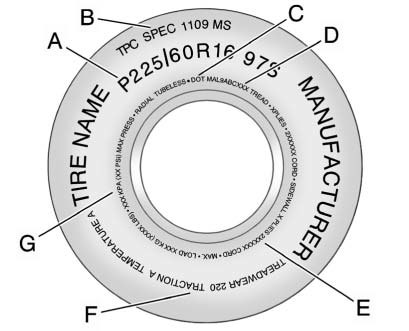
Passenger (P-Metric) Tire Example
(A) Tire Size: The tire size is a combination of letters and numbers used to define a particular tire's width, height, aspect ratio, construction type, and service description. See the “Tire Size” illustration later in this section for more detail.
The tire size must match the vehicle’s required specifications. Installing the wrong size can affect speedometer accuracy, handling, braking, ride height, clearance, traction control operation, and overall driving feel.
(B) TPC Spec (Tire Performance Criteria Specification): Original equipment tires designed to GM's specific tire performance criteria have a TPC specification code molded onto the sidewall.
GM's TPC specifications meet or exceed all federal safety guidelines.
The TPC code helps identify tires that were developed to meet specific performance targets. For the Buick Enclave, using tires that match the intended specification helps preserve the ride, handling, load capability, and braking characteristics designed for the vehicle.
(C) DOT (Department of Transportation): The Department of Transportation (DOT) code indicates that the tire is in compliance with the U.S. Department of Transportation Motor Vehicle Safety Standards.
(D) Tire Identification Number (TIN): The letters and numbers following the DOT (Department of Transportation) code are the Tire Identification Number (TIN). The TIN shows the manufacturer and plant code, tire size, and date the tire was manufactured. The TIN is molded onto both sides of the tire, although only one side may have the date of manufacture.
The date portion of the TIN can be useful when evaluating tire age. Even if tread remains, older tires may become less flexible and more prone to cracking or reduced performance.
(E) Tire Ply Material: The type of cord and number of plies in the sidewall and under the tread.
Ply material information describes the internal construction of the tire. This can include materials such as polyester, steel, nylon, or other reinforcing cords used to give the tire strength and shape.
(F) Uniform Tire Quality Grading (UTQG): Tire manufacturers are required to grade tires based on three performance factors: treadwear, traction, and temperature resistance. For more information see Uniform Tire Quality Grading.
UTQG ratings can help compare certain tire characteristics, but they should not be the only factor used when selecting replacement tires. Tire size, load rating, speed rating, type, climate suitability, and vehicle manufacturer recommendations are also important.
(G) Maximum Cold Inflation Load Limit: Maximum load that can be carried and the maximum pressure needed to support that load.
This number is not the same as the recommended tire pressure for normal vehicle use. The recommended pressure should be taken from the vehicle tire information label, not simply from the maximum pressure molded into the tire sidewall.
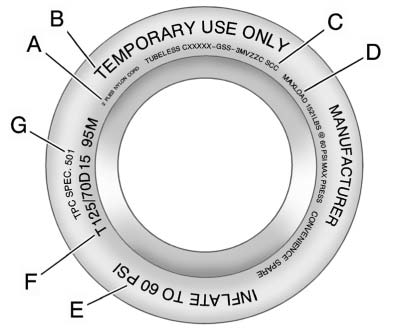
Compact Spare Tire Example
(A) Tire Ply Material: The type of cord and number of plies in the sidewall and under the tread.
(B) Temporary Use Only:
The compact spare tire or temporary use tire has a tread life of approximately 5 000 km (3,000 mi) and should not be driven at speeds over 105 km/h (65 mph). The compact spare tire is for emergency use when a regular road tire has lost air and gone flat. If the vehicle has a compact spare tire, see Compact Spare Tire and If a Tire Goes Flat.
A compact spare tire is not intended to replace a regular tire for everyday driving. It is narrower, has different handling characteristics, and may affect braking, traction, and stability if used beyond its intended temporary purpose.
(C) Tire Identification Number (TIN): The letters and numbers following the DOT (Department of Transportation) code are the Tire Identification Number (TIN). The TIN shows the manufacturer and plant code, tire size, and date the tire was manufactured. The TIN is molded onto both sides of the tire, although only one side may have the date of manufacture.
(D) Maximum Cold Inflation Load Limit: Maximum load that can be carried and the maximum pressure needed to support that load.
(E) Tire Inflation: The temporary use tire or compact spare tire should be inflated to 420 kPa (60 psi). For more information on tire pressure and inflation see Tire Pressure.
Because compact spare tires often require a higher pressure than regular road tires, the pressure should be checked before the spare is needed. A compact spare that is underinflated may not safely support the vehicle during emergency use.
(F) Tire Size: A combination of letters and numbers define a tire's width, height, aspect ratio, construction type, and service description. The letter T as the first character in the tire size means the tire is for temporary use only.
(G) TPC Spec (Tire Performance Criteria Specification): Original equipment tires designed to GM's specific tire performance criteria have a TPC specification code molded onto the sidewall.
GM's TPC specifications meet or exceed all federal safety guidelines.
When selecting or replacing tires, always use specifications appropriate for the vehicle and driving conditions. Correct tire selection helps the Buick Enclave maintain predictable handling, safe braking, proper load capacity, and comfortable ride quality.
Tire Designations
Tire Size
The following is an example of a typical passenger vehicle tire size. Tire size markings are important because they describe the tire’s physical dimensions, construction, wheel fitment, load capability, and speed classification. Understanding this information helps ensure that replacement tires match the vehicle’s requirements.
For the Buick Enclave, using the correct tire size is essential for predictable handling, proper ride height, accurate vehicle systems, safe load support, and balanced braking performance. A tire that looks similar may still have a different rating or construction, so the full sidewall designation should always be checked.
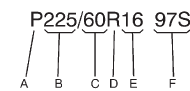
(A) Passenger (P-Metric) Tire:
This identifies the United States version of a metric tire sizing system. The letter P as the first character in the tire size means the tire is a passenger vehicle tire engineered to standards set by the U.S. Tire and Rim Association.
Passenger tires are designed for vehicles that carry people and normal cargo loads, rather than heavy commercial loads. The P-Metric marking helps distinguish this type of tire from other tire categories, such as light truck tires or temporary spare tires.
(B) Tire Width: The three-digit number indicates the tire section width in millimeters from sidewall to sidewall.
This width measurement affects the tire’s contact patch, steering feel, road grip, and clearance around suspension and body components. A tire that is too wide or too narrow may change how the vehicle rides and handles.
(C) Aspect Ratio: A two-digit number that indicates the tire height-to-width relationship.
For example, if the tire size aspect ratio is 60, as shown in item C of the illustration, it means that the tire’s sidewall height is 60 percent of the tire’s width. A lower aspect ratio generally means a shorter sidewall, while a higher aspect ratio means a taller sidewall.
Sidewall height can influence ride comfort, steering response, wheel protection, and road feel. This is why the aspect ratio should match the tire specification intended for the vehicle.
(D) Construction Code: A letter code is used to indicate the type of ply construction in the tire. The letter R means radial ply construction; the letter D means diagonal or bias ply construction; and the letter B means belted-bias ply construction.
Most modern passenger vehicles use radial tires because they provide a good balance of durability, ride quality, traction, and fuel efficiency. The construction code should always match the type of tire recommended for the vehicle.
(E) Rim Diameter: Diameter of the wheel in inches.
This number tells you what wheel size the tire is designed to fit. A tire must be mounted only on a wheel with the correct rim diameter. Using the wrong rim diameter is unsafe and can prevent the tire from seating properly.
(F) Service Description: These characters represent the load index and speed rating of the tire. The load index represents the load-carrying capacity a tire is certified to carry. The speed rating is the maximum speed at which a tire is certified to carry a load.
The service description is especially important when selecting replacement tires. Tires with an incorrect load index or speed rating may not support the vehicle properly or may not perform as expected under highway driving, heavy passenger load, or long-distance travel.
Tire Terminology and Definitions
Air Pressure: The amount of air inside the tire pressing outward on each square inch of the tire. Air pressure is expressed in kPa (kilopascal) or psi (pounds per square inch).
Correct air pressure helps the tire maintain its shape, carry the vehicle load, wear evenly, and provide stable handling. Too little or too much pressure can affect safety, comfort, fuel economy, and tire life.
Accessory Weight: The combined weight of optional accessories. Some examples of optional accessories are automatic transmission, power steering, power brakes, power windows, power seats, and air conditioning.
This weight is considered when determining vehicle load capacity and tire loading. Added equipment can increase the total weight the tires must support.
Aspect Ratio: The relationship of a tire's height to its width.
The aspect ratio helps describe the tire’s sidewall profile. It can influence ride comfort, steering response, and the way the tire absorbs road impacts.
Belt: A rubber-coated layer of cords that is located between the plies and the tread. Cords may be made from steel or other reinforcing materials.
Belts help strengthen the tread area, improve stability, and support the tire’s contact with the road surface.
Bead: The tire bead contains steel wires wrapped by steel cords that hold the tire onto the rim.
The bead must seat firmly against the rim to maintain air pressure and keep the tire secure during driving, cornering, and braking.
Bias Ply Tire: A pneumatic tire in which the plies are laid at alternate angles less than 90 degrees to the centerline of the tread.
This type of construction is different from radial construction and is not typically used as the standard tire design on modern passenger vehicles.
Cold Tire Pressure: The amount of air pressure in a tire, measured in kPa (kilopascal) or psi (pounds per square inch), before a tire has built up heat from driving. See Tire Pressure.
Cold pressure should be checked before the vehicle has been driven for a long distance. Heat from driving raises pressure, which can make a hot tire reading misleading.
Curb Weight: The weight of a motor vehicle with standard and optional equipment, including the maximum capacity of fuel, oil, and coolant, but without passengers and cargo.
Curb weight is part of the calculation used to determine how much additional passenger and cargo weight the vehicle can safely carry.
DOT Markings: A code molded into the sidewall of a tire signifying that the tire is in compliance with the U.S. Department of Transportation (DOT) Motor Vehicle Safety Standards.
The DOT code includes the Tire Identification Number (TIN), an alphanumeric designator that can also identify the tire manufacturer, production plant, brand, and date of production.
The production date is useful when evaluating tire age. Even if the tread appears acceptable, older tires may lose flexibility and develop cracking or reduced performance over time.
GVWR: Gross Vehicle Weight Rating. See Vehicle Load Limits.
This is the maximum total loaded weight of the vehicle, including passengers, cargo, fluids, and equipment. The Buick Enclave should never be loaded beyond its rated capacity.
GAWR FRT: Gross Axle Weight Rating for the front axle. See Vehicle Load Limits.
This rating identifies the maximum weight that can be supported by the front axle and its related tires, wheels, suspension, and structure.
GAWR RR: Gross Axle Weight Rating for the rear axle. See Vehicle Load Limits.
This rating identifies the maximum weight that can be supported by the rear axle. Cargo loading should be balanced so the rear axle is not overloaded.
Intended Outboard Sidewall:
The side of an asymmetrical tire that must always face outward when mounted on a vehicle.
Asymmetrical tires are designed with specific inner and outer tread areas. Mounting them incorrectly can reduce performance, wet traction, and handling stability.
Kilopascal (kPa): The metric unit for air pressure.
Tire pressures may be listed in both kPa and psi, depending on the label, gauge, or service information being used.
Light Truck (LT-Metric) Tire: A tire used on light duty trucks and some multipurpose passenger vehicles.
LT-Metric tires are designed for different load and service requirements than standard passenger tires. They should not be substituted unless they are specifically appropriate for the vehicle.
Load Index: An assigned number ranging from 1 to 279 that corresponds to the load-carrying capacity of a tire.
The load index must be suitable for the vehicle. Installing tires with a lower load index than required can reduce safety and durability.
Maximum Inflation Pressure:
The maximum air pressure to which a cold tire can be inflated.
The maximum air pressure is molded onto the sidewall.
This number is not the same as the recommended tire pressure for normal driving. The recommended pressure should be taken from the vehicle placard, not simply from the maximum value printed on the tire.
Maximum Load Rating:
The load rating for a tire at the maximum permissible inflation pressure for that tire.
This rating describes the highest load the tire can carry when inflated to the pressure specified for that maximum load condition.
Maximum Loaded Vehicle Weight: The sum of curb weight, accessory weight, vehicle capacity weight, and production options weight.
This represents the fully loaded condition of the vehicle and is important when considering passenger load, luggage, cargo, and installed equipment.
Normal Occupant Weight:
The number of occupants a vehicle is designed to seat multiplied by 68 kg (150 lbs). See Vehicle Load Limits.
This value is used as a standard calculation for load ratings and vehicle capacity information.
Occupant Distribution:
Designated seating positions.
Proper occupant distribution helps keep the vehicle balanced and prevents overloading one axle or side of the vehicle.
Outward Facing Sidewall:
The side of an asymmetrical tire that has a particular side that faces outward when mounted on a vehicle. The side of the tire that contains a whitewall, bears white lettering, or bears manufacturer, brand, and/or model name molding that is higher or deeper than the same moldings on the other sidewall of the tire.
Correct sidewall orientation helps the tire perform as designed. If the tire has markings such as “outside” or similar wording, those markings should face outward after installation.
Passenger (P-Metric) Tire:
► A tire used on passenger cars and some light duty trucks and multipurpose vehicles.
This tire type is common on many vehicles designed primarily for passenger transportation and everyday road use.
Recommended Inflation Pressure: Vehicle manufacturer's recommended tire inflation pressure as shown on the tire placard.
See Tire Pressure and Vehicle Load Limits.
The recommended inflation pressure is selected to support the vehicle correctly while balancing ride comfort, tire wear, braking, handling, and fuel economy. For the Buick Enclave, this pressure should be followed rather than guessing based on the tire sidewall maximum.
Radial Ply Tire: A pneumatic tire in which the ply cords that extend to the beads are laid at 90 degrees to the centerline of the tread.
Radial construction is widely used because it provides good tread life, road contact, ride quality, and overall performance.
Rim: A metal support for a tire and upon which the tire beads are seated.
The rim must be the correct diameter and width for the tire. Damage, corrosion, or bending of the rim can affect sealing, balance, and safe operation.
Sidewall: The portion of a tire between the tread and the bead.
The sidewall contains important tire information and also helps absorb road impacts. Cuts, bulges, cracking, or exposed cords on the sidewall can indicate an unsafe tire.
Speed Rating: An alphanumeric code assigned to a tire indicating the maximum speed at which a tire can operate.
The speed rating must be appropriate for the vehicle and driving conditions. It works together with the load rating and tire construction to define safe tire capability.
Traction: The friction between the tire and the road surface.
The amount of grip provided.
Traction affects acceleration, braking, cornering, and control on dry, wet, snowy, or uneven roads.
Tread: The portion of a tire that comes into contact with the road.
The tread pattern helps move water, snow, and debris away from the contact area while providing grip and stability.
Treadwear Indicators: Narrow bands, sometimes called wear bars, that show across the tread of a tire when only 1.6 mm (1/16 in) of tread remains.
See When It Is Time for New Tires.
When these wear bars become level with the tread surface, the tire has reached the minimum tread depth and should be replaced. Waiting too long can reduce wet traction and increase stopping distance.
UTQGS (Uniform Tire Quality Grading Standards):
► A tire information system that provides consumers with ratings for a tire's traction, temperature, and treadwear.
Ratings are determined by tire manufacturers using government testing procedures.
The ratings are molded into the sidewall of the tire.
See Uniform Tire Quality Grading.
UTQGS ratings can help compare certain tire characteristics, but they should be considered together with the correct size, load rating, speed rating, season, and intended driving conditions.
Vehicle Capacity Weight:
The number of designated seating positions multiplied by 68 kg (150 lbs) plus the rated cargo load. See Vehicle Load Limits.
This value helps determine how much combined passenger and cargo weight the vehicle can safely carry.
Vehicle Maximum Load on the Tire: Load on an individual tire due to curb weight, accessory weight, occupant weight, and cargo weight.
Each tire carries only part of the vehicle’s total weight, but overloading one area can place excessive stress on individual tires and suspension components.
Vehicle Placard: A label permanently attached to a vehicle showing the vehicle capacity weight and the original equipment tire size and recommended inflation pressure. See “Tire and Loading Information Label” under Vehicle Load Limits.
The vehicle placard should be one of the main references when checking tire size, tire pressure, and loading information. Following the placard helps maintain the intended safety, ride, and handling characteristics of the Buick Enclave.
