
Buick Enclave: Safety Belts
This section explains how to use safety belts correctly and why proper belt use is so important. It also highlights several things that should never be done when using safety belts.
 WARNING
Do not allow anyone to ride in a position where a safety belt cannot be worn properly. In a crash, injuries can be much more severe if you or your passengers are not wearing safety belts.
You can be seriously injured or killed by striking parts of the vehicle interior more forcefully or by being ejected from the vehicle.
In addition, anyone who is not buckled up can be thrown into other occupants inside the vehicle. Riding in a cargo area, whether inside or outside the vehicle, is extremely dangerous. In a collision, passengers in those areas are more likely to be seriously injured or killed. Do not allow passengers to ride in any area of the vehicle that is not equipped with seats and safety belts.
Always wear a safety belt, and always make sure all passengers are restrained properly as well.
This Buick Enclave is equipped with reminder indicators to help prompt occupants to buckle their safety belts.
See Safety Belt Reminders for additional information.
Why Safety Belts Work
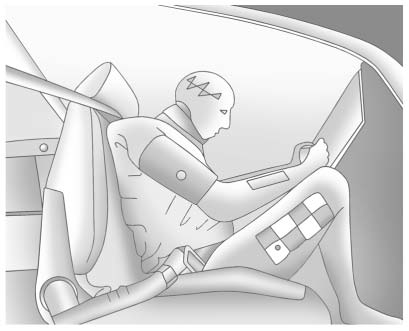
When riding in a moving vehicle, you travel at the same speed as the vehicle itself. If the vehicle stops suddenly, your body continues moving until something stops it.
That “something” could be the windshield, the instrument panel, or the safety belts.
When a safety belt is worn properly, you and the vehicle slow down together.
There is more time and distance for your body to come to a stop, and the strongest bones in your body are able to absorb the forces from the safety belt more effectively. That is why wearing safety belts makes so much sense in the Buick Enclave and in any other vehicle.
Questions and Answers About Safety Belts
Q: Will I be trapped in the vehicle after a crash if I am wearing a safety belt?
A: You could be — whether you are wearing a safety belt or not.
Your chances of remaining conscious during and after a crash, so that you can unbuckle and get out, are much greater if you are properly belted.
Q: If my vehicle has airbags, why should I still wear safety belts?
A: Airbags are supplemental systems only. They are designed to work together with safety belts, not replace them. Whether or not a vehicle is equipped with airbags, all occupants still need to buckle up to receive the best possible protection.
Also, in nearly all states and throughout all Canadian provinces, the law requires safety belt use.
For the Buick Enclave, the best protection comes from using every restraint system correctly: sit properly, buckle up every trip, and make sure every passenger does the same before the vehicle starts moving.
- How to Wear Safety Belts Properly. Lap-Shoulder Belt. Safety Belt Use During Pregnancy
- Safety Belt Extender. Safety System Check. Safety Belt Care
- Replacing Safety Belt System Parts after a Crash
