
Buick Enclave: If the Vehicle Is Stuck. Vehicle Load Limits
If the Vehicle Is Stuck
Slowly and cautiously spin the wheels to help free the vehicle when it is stuck in sand, mud, ice, or snow. The goal is to create a small amount of movement without digging the tires deeper into the surface. Excessive wheelspin can make the situation worse and may damage the vehicle.
If the vehicle has a traction system, it can often help free a stuck vehicle by managing wheelspin and improving available grip. Refer to the vehicle's traction system in the Index. If the vehicle is stuck too severely for the traction system to free it, turn the traction system off and use the rocking method carefully.
 WARNING
If the vehicle's tires spin at high speed, they can explode, and you or others
could be injured.
The vehicle can overheat, causing an engine compartment fire or other damage. Spin the wheels as little as possible and avoid going above 55 km/h (35 mph).
For information about using tire chains on the vehicle, see Tire Chains. Tire chains must be used only when they are approved for the vehicle and road conditions. Improper use can damage tires, suspension components, brake parts, or body panels.
Rocking the Vehicle to Get it Out
Turn the steering wheel left and right to clear the area around the front wheels. This may help the tires find a firmer surface and create a path for movement. Remove packed snow, mud, or loose material from around the tires if it is safe to do so.
Turn off any traction or stability system if the vehicle is stuck too deeply for the system to help. Shift back and forth between R (Reverse) and a forward gear, spinning the wheels as little as possible. To prevent transmission wear, wait until the wheels stop spinning before shifting gears. Release the accelerator pedal while shifting, and press lightly on the accelerator pedal when the transmission is in gear.
Slowly spinning the wheels in forward and reverse directions creates a rocking motion that may free the vehicle. The movement should be gentle and controlled. If the tires begin to dig deeper, stop and try clearing the area around the wheels or adding traction material such as sand, gravel, or floor mats placed safely under the tires.
If rocking the Buick Enclave does not free the vehicle after a few careful tries, it may need to be towed out. Continuing to spin the wheels can overheat components, damage the transmission, or make the vehicle harder to recover. If the vehicle does need to be towed out, see Towing the Vehicle.
When the vehicle becomes free, accelerate slowly and continue driving with caution. Snow, mud, sand, or ice may still reduce traction nearby, so avoid sudden throttle, braking, or steering inputs until the vehicle is back on a stable surface.
Vehicle Load Limits
It is very important to understand how much weight your vehicle is designed to carry before loading passengers, luggage, tools, accessories, or other cargo. This total allowable weight is called the vehicle capacity weight. It includes the weight of all occupants, all cargo, and any options or equipment that were not installed at the factory. Staying within the proper load limit helps the Buick Enclave handle, brake, steer, and ride as intended.
Two labels on your vehicle provide the key information needed to determine how much weight it may properly carry: the Tire and Loading Information label and the Certification/Tire label. These labels should be checked whenever the vehicle will be carrying several passengers, heavy cargo, or towing-related equipment.
WARNING
Do not load the vehicle any heavier than the Gross Vehicle Weight Rating (GVWR),
or either the maximum front or rear Gross Axle Weight Rating (GAWR).
This can cause systems to break and change the way the vehicle handles. This could cause loss of control and a crash. Overloading can also shorten the life of the vehicle.
Overloading is not only a matter of comfort or fuel economy. Too much weight can place excessive stress on the suspension, tires, brakes, steering components, drivetrain, and body structure. It may also increase stopping distance, reduce stability in turns, and make the vehicle harder to control during emergency maneuvers.
Tire and Loading Information Label
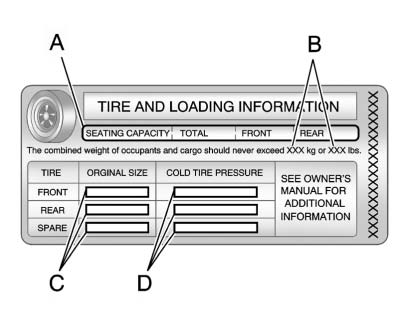
Example Label
► A vehicle specific Tire and Loading Information label is attached to the center pillar, also called the B-pillar, of your vehicle. With the driver's door open, you will find the label attached below the door lock post, also known as the striker. The Tire and Loading Information label shows the number of occupant seating positions (A), and the maximum vehicle capacity weight (B) in kilograms and pounds.The Tire and Loading Information label also shows the size of the original equipment tires (C) and the recommended cold tire inflation pressures (D). These pressures are based on the tires being cold, meaning the vehicle has not been driven for several hours or has been driven only a short distance at low speed. For more information on tires and inflation see Tires and Tire Pressure.
Correct tire pressure is especially important when the vehicle is loaded. Underinflated tires can overheat, wear unevenly, reduce fuel efficiency, and affect handling. Overinflated tires can reduce ride comfort and may also affect traction. Always use the pressure listed on the vehicle label rather than the maximum pressure molded into the tire sidewall.
There is also important loading information on the vehicle Certification/Tire label. It tells you the Gross Vehicle Weight Rating (GVWR) and the Gross Axle Weight Rating (GAWR) for the front and rear axle. The GVWR is the maximum total loaded weight of the vehicle, while GAWR identifies the maximum weight that each axle is designed to support.
See “Certification/Tire Label” later in this section.
When loading the Buick Enclave, distribute weight as evenly as possible. Heavy items should be placed low and secured so they cannot slide during braking, turning, or sudden stops. Loose cargo can shift unexpectedly and change the way the vehicle responds on the road.
Steps for Determining Correct Load Limit
1. Locate the statement “The combined weight of occupants and cargo should never exceed XXX kg or XXX lbs” on your vehicle's placard.
2. Determine the combined weight of the driver and passengers that will be riding in your vehicle.
3. Subtract the combined weight of the driver and passengers from XXX kg or XXX lbs.
4. The resulting figure equals the available amount of cargo and luggage load capacity.
For example, if the “XXX” amount equals 1400 lbs and there will be five 150 lb passengers in your vehicle, the amount of available cargo and luggage load capacity is 650 lbs (1400 − 750 (5 x 150) = 650 lbs).
5. Determine the combined weight of luggage and cargo being loaded on the vehicle.
That weight may not safely exceed the available cargo and luggage load capacity calculated in Step 4. This includes suitcases, sports equipment, tools, coolers, roof cargo, aftermarket accessories, and any other items being carried in or on the vehicle.
6. If your vehicle will be towing a trailer, the load from your trailer will be transferred to your vehicle. Consult this manual to determine how this reduces the available cargo and luggage load capacity for your vehicle.
See Trailer Towing for important information on towing a trailer, towing safety rules and trailering tips.
It is important to remember that passengers and cargo are both part of the same total weight calculation. Adding more passengers reduces the amount of cargo that can be carried safely. Adding heavy cargo reduces the available capacity for passengers or towing-related load. For the Buick Enclave, using the label information correctly helps keep the vehicle within its intended operating limits.
If the vehicle is loaded close to its maximum capacity, drive more cautiously. Allow extra stopping distance, avoid sudden steering movements, reduce speed on rough roads, and be especially careful on hills, curves, and wet or slippery surfaces. A heavily loaded vehicle may feel different from the way it feels when lightly loaded.
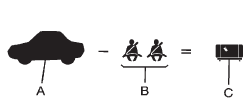
Example 1
A. Vehicle Capacity Weight for Example 1 = 453 kg (1,000 lbs).
B. Subtract Occupant Weight @ 68 kg (150 lbs) × 2 = 136 kg (300 lbs).
C. Available Occupant and Cargo Weight = 317 kg (700 lbs).
In this example, two occupants use part of the total available capacity, leaving 317 kg (700 lbs) for additional occupants and cargo. Before adding luggage or equipment, compare the remaining capacity with the actual weight of the items being loaded. This simple calculation helps prevent accidental overloading and supports safer vehicle operation.
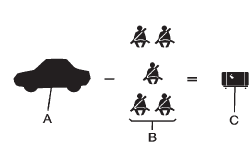
Example 2
A. Vehicle Capacity Weight for Example 2 = 453 kg (1,000 lbs).
B. Subtract Occupant Weight @ 68 kg (150 lbs) × 5 = 340 kg (750 lbs).
C. Available Cargo Weight = 113 kg (250 lbs).
In this example, five occupants use a large portion of the total available vehicle capacity weight. After subtracting the combined occupant weight, only 113 kg (250 lbs) remains for cargo. This remaining amount must include all luggage, bags, tools, equipment, accessories, and any other items placed in or on the vehicle.
This example shows why it is important to calculate passenger and cargo weight together. Even when there is still room inside the cabin or cargo area, the vehicle may already be close to its safe load limit. Space inside the Buick Enclave should never be used as the only guide for how much weight can be carried.
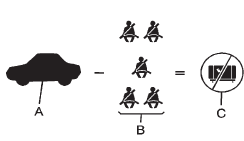
Example 3
A. Vehicle Capacity Weight for Example 3 = 453 kg (1,000 lbs).
B. Subtract Occupant Weight @ 91 kg (200 lbs) × 5 = 453 kg (1,000 lbs).
C. Available Cargo Weight = 0 kg (0 lbs).
In this example, the combined weight of the occupants uses the entire vehicle capacity weight. Because the full 453 kg (1,000 lbs) capacity has already been reached, there is no remaining safe capacity for additional cargo. Adding luggage, equipment, or other items in this situation would exceed the stated limit and could affect braking, handling, tire performance, and vehicle durability.
Refer to your vehicle's Tire and Loading Information label for specific information about your vehicle's capacity weight and seating positions. The combined weight of the driver, passengers, and cargo should never exceed your vehicle's capacity weight. This label provides the correct numbers for the specific vehicle, so it should always be used instead of estimating or relying only on general examples.
When preparing the Buick Enclave for a trip, consider the weight of every person and every item being carried. Suitcases, sports gear, coolers, roof cargo, child seats, tools, and aftermarket accessories can add weight quickly. A careful check before driving helps keep the vehicle within its intended operating range.
Certification/Tire Label
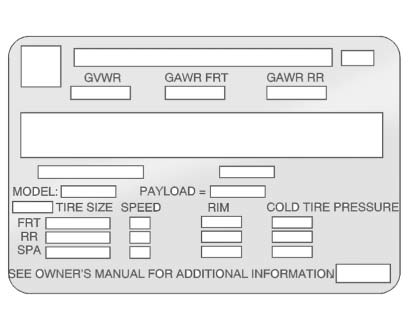
Label Example
► A vehicle specific Certification/Tire label is attached to the rear edge of the driver's door.The label shows the gross weight capacity of your vehicle.
This is called the Gross Vehicle Weight Rating (GVWR).
The GVWR includes the weight of the vehicle, all occupants, fuel, and cargo. It represents the maximum total loaded weight the vehicle is designed to carry safely when everything is included.
The Certification/Tire label also tells you the maximum weights for the front and rear axles, called the Gross Axle Weight Rating (GAWR). The front and rear axle limits are important because weight must not only be within the total GVWR, but also properly distributed across the vehicle. Too much weight over one axle can create unsafe handling even if the total vehicle weight appears acceptable.
To find out the actual loads on your front and rear axles, you need to go to a weigh station and weigh your vehicle. Your dealer can help you with this. Be sure to spread out your load equally on both sides of the centerline. Balanced loading helps the vehicle remain more stable during braking, cornering, and emergency maneuvers.
Never exceed the GVWR for your vehicle or the GAWR for either the front or rear axle. These ratings are engineering limits, not suggestions. Staying within them helps protect the suspension, tires, brakes, steering system, transmission, and body structure.
WARNING
Do not load the vehicle any heavier than the Gross Vehicle Weight Rating (GVWR),
or either the maximum front or rear Gross Axle Weight Rating (GAWR).
This can cause systems to break and change the way the vehicle handles. This could cause loss of control and a crash. Overloading can also shorten the life of the vehicle.
Notice : Overloading the vehicle may cause damage.
Repairs would not be covered by the vehicle warranty.
Do not overload the vehicle.
Overloading can lead to premature wear or failure of important components. It can also make the vehicle feel less responsive, increase stopping distance, reduce tire life, and create more heat in the braking system. For safe operation, always respect the load ratings shown on the vehicle labels.
If you put things inside your vehicle — like suitcases, tools, packages, or anything else, they will go as fast as the vehicle goes. If you have to stop or turn quickly, or if there is a crash, they will keep going.
Loose cargo can become a hazard during sudden braking or a collision. Even items that seem light can strike occupants with significant force when the vehicle stops abruptly. Heavy items should be placed low, positioned securely, and kept in the cargo area whenever possible.
WARNING
Things you put inside the vehicle can strike and injure people in a sudden stop
or turn, or in a crash.
► Never stack heavier things, like suitcases, inside the vehicle so that some of them are above the tops of the seats. Heavy items placed too high can move forward or sideways during a sudden stop or turn.
► Do not leave an unsecured child restraint in the vehicle.
► When you carry something inside the vehicle, secure it whenever you can.
► Do not leave a seat folded down unless you need to.Keeping seats upright when they are not needed for cargo can help maintain proper separation between the passenger area and the load area. It can also help prevent cargo from shifting forward during a sudden stop.
Before driving, check that cargo is not blocking visibility, interfering with seat belts, pressing against doors, or resting where it could affect pedals or passenger movement. In the Buick Enclave, proper loading is part of safe everyday use, especially when traveling with several passengers or carrying heavy luggage.
A careful loading routine helps preserve comfort, control, and vehicle reliability. Use the Tire and Loading Information label, follow the Certification/Tire label ratings, secure cargo properly, and adjust driving style when the vehicle is heavily loaded.
