
Buick Enclave: Older Children. Infants and Young Children. Child Restraint Systems
Older Children
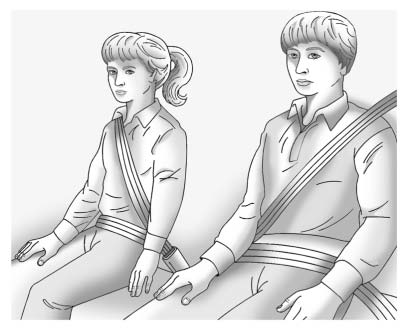
In the Buick Enclave, older children who have outgrown booster seats should use the vehicle safety belts, but only when the belt fits them correctly and can be worn in the proper position for the entire trip.
The instructions supplied with the booster seat list the specific weight and height limits for that seat. A child should continue using a booster seat with a lap-shoulder belt until the child can pass the fit check below without help and without changing position while riding.
► Have the child sit all the way back against the seatback.
Do the child’s knees bend naturally at the edge of the seat cushion? If yes, continue with the next step. If no, the child should return to the booster seat.
► Buckle the lap-shoulder belt.
Does the shoulder belt rest properly on the shoulder? If yes, continue.
If no, try using the rear safety belt comfort guide. See “Rear Safety Belt Comfort Guides” under Lap-Shoulder Belt for more information.
If the shoulder belt still does not stay on the shoulder, the child should continue using the booster seat.
► Check the lap belt position. Does the lap belt fit low and snug on the hips, touching the upper thighs? If yes, continue. If no, the child should return to the booster seat.
► Can the child keep the correct safety belt position for the full length of the trip without slouching, leaning, or moving the belt out of place? If yes, the vehicle safety belt may fit properly. If no, the child should continue using the booster seat.
Q: What is the proper way for an older child to wear safety belts?
A: An older child should use a lap-shoulder belt because the shoulder portion provides important additional restraint. The shoulder belt should lie across the shoulder and chest, not across the face, neck, or upper arm. The lap belt should fit snugly below the hips and should touch the top of the thighs.
This position helps apply crash forces to the child’s pelvic bones, which are better able to manage those forces during a collision.
The lap belt should never be worn over the abdomen. If the belt is positioned on the stomach, a crash could cause severe or even fatal internal injuries.
Also see “Rear Safety Belt Comfort Guides” under Lap-Shoulder Belt.
Before allowing a child to use only the Buick Enclave safety belt, make sure the child can sit upright, remain properly positioned, and keep both the lap belt and shoulder belt in the correct place during normal driving, braking, and turns.
According to accident statistics, children and infants are safer when they are properly restrained in an appropriate child restraint system or infant restraint system secured in a rear seating position.
In a crash, children who are not buckled up can strike other occupants who are properly restrained, or they can be thrown from the vehicle. Older children need to use safety belts correctly every time they ride.
 WARNING
Never do this.
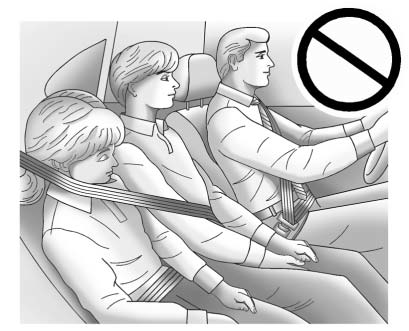
Never allow two children to wear the same safety belt. A single safety belt cannot properly spread crash forces across two occupants. In a collision, the two children can be pressed together with extreme force and may be seriously injured. A safety belt must be used by only one person at a time.
WARNING
Never do this.
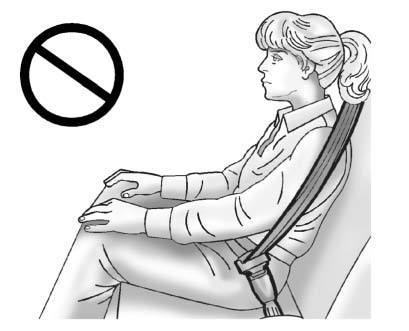
Never allow a child to wear the safety belt with the shoulder belt behind their back. A child can be seriously injured if the lap-shoulder belt is not worn correctly.
In a crash, the child would not be restrained by the shoulder belt. The child could move too far forward, increasing the risk of head and neck injuries. The child could also slide under the lap belt, causing the belt force to be applied directly to the abdomen.
This could cause serious or fatal injuries. The shoulder belt should always go over the shoulder and across the chest.
Infants and Young Children
Everyone in a vehicle needs protection, including infants and all young children. The length of the trip, the child’s age, and the child’s size do not remove the need for proper safety restraints. Every ride requires the correct restraint system for the passenger.
In the United States, every state has laws requiring children up to a certain age to be restrained while riding in a vehicle. Canadian provinces also have child restraint requirements. Always follow the laws that apply where the vehicle is being driven.
WARNING
Children can be seriously injured or strangled if a shoulder belt wraps around their neck and the safety belt continues to tighten. Never leave children unattended in a vehicle, and never allow children to play with the safety belts.
Airbags and lap-shoulder belts are designed to help protect adults and older children, but they are not designed to restrain infants or young children by themselves. The vehicle safety belt system and airbag system cannot replace a properly selected and properly installed child restraint.
When infants or young children ride in the Buick Enclave, they should always be protected by an appropriate child restraint that matches their size, weight, age, and developmental stage.
Children who are not properly restrained can strike other occupants, hard interior surfaces, or can be thrown from the vehicle during a crash or sudden stop.
WARNING
Never do this.
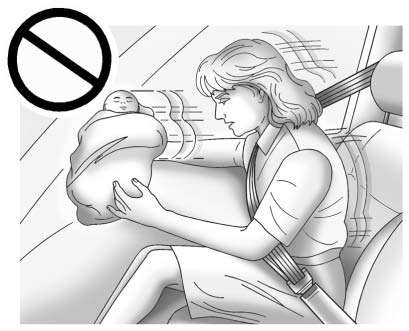
Never hold an infant or child in your arms while riding in a vehicle. Crash forces can make even a small child impossible to hold securely during a collision.
For example, in a crash at only 40 km/h (25 mph), a 5.5 kg (12 lb) infant can suddenly produce about 110 kg (240 lb) of force on a person’s arms. An infant should always be secured in an appropriate restraint.
WARNING
Never do this.
Children who are against, or very close to, any airbag when it inflates can be seriously injured or killed. Never place a rear-facing child restraint in the right front passenger seat. Secure a rear-facing child restraint in a rear seat.
It is also better to secure a forward-facing child restraint in a rear seat. If a forward-facing child restraint must be secured in the right front passenger seat, always move the front passenger seat as far back as it will go.
Q: What are the different types of add-on child restraints?
A: Add-on child restraints are purchased separately by the vehicle owner and are generally available in four basic types. Choosing the correct restraint requires considering the child’s weight, height, and age, as well as whether the restraint is compatible with the vehicle seat and belt system where it will be installed.
For most basic types of child restraints, many different models are available. The best choice is the restraint that fits the child, fits the seating position, and can be installed and used correctly every time.
When purchasing a child restraint, make sure it is designed for use in a motor vehicle.
If it is approved for motor vehicle use, the restraint will have a label stating that it meets federal motor vehicle safety standards.
The manufacturer’s instructions supplied with the restraint describe the weight and height limitations for that specific child restraint. There are also many types of restraints available for children with special needs.
For the Buick Enclave, always review both the child restraint instructions and the vehicle information before installation, especially when choosing between rear-facing, forward-facing, booster, and special-needs restraint systems.
WARNING
To reduce the risk of neck and head injury during a crash, infants need complete support. An infant’s neck is not fully developed, and the head is large and heavy compared with the rest of the body. In a crash, an infant in a rear-facing child restraint settles into the restraint, allowing crash forces to be distributed across the strongest areas of the infant’s body, including the back and shoulders. Infants should always be secured in rear-facing child restraints.
WARNING
A young child’s hip bones are still too small for the vehicle’s regular safety belt to remain low on the hip bones as it should.
Instead, the belt may ride up onto the child’s abdomen. In a crash, the belt would apply force to an area of the body that is not protected by strong bone structure. This alone could cause serious or fatal injuries. To reduce the risk of serious or fatal injury during a crash, young children should always be secured in appropriate child restraints.
Child Restraint Systems
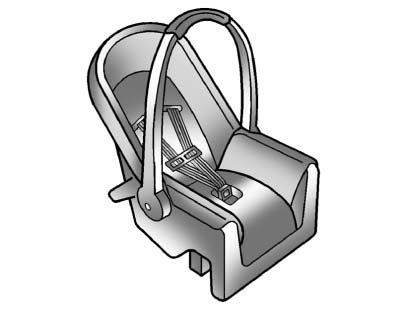
(A) Rear-Facing Infant Seat
► A rear-facing infant seat (A) is designed to support the infant with the seating surface positioned against the infant’s back.
The harness system holds the infant securely in place. During a crash, it helps keep the infant properly positioned within the restraint so crash forces can be managed by the restraint structure rather than by the child’s body alone.
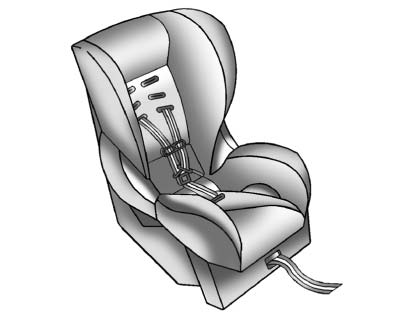
(B) Forward-Facing Child Seat
► A forward-facing child seat (B) provides restraint for the child’s body by using an integrated harness system.
This type of child restraint is intended for children who have outgrown a rear-facing restraint but still need the additional support and controlled positioning provided by a harness.
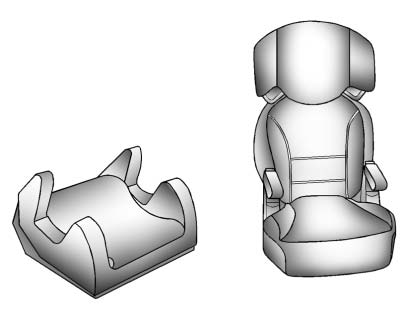
(C) Booster Seats
► A booster seat (C) is a child restraint designed to improve how the vehicle safety belt fits an older child.
► A booster seat can help position the lap-shoulder belt correctly across the child’s body and may also allow the child to sit higher for better visibility through the window.
In the Buick Enclave, a booster seat should be used until the child is large enough for the vehicle safety belt to fit correctly without extra support.
Securing an Add-On Child Restraint in the Vehicle
WARNING
A child can be seriously injured or killed in a crash if the child restraint is not properly secured in the vehicle. Secure the child restraint correctly using the vehicle safety belt or the LATCH system, and always follow both the instructions supplied with the child restraint and the instructions in this manual.
To help reduce the risk of injury, every child restraint must be firmly secured in the vehicle before use. Child restraint systems may be attached to vehicle seats with lap belts, with the lap belt portion of a lap-shoulder belt, or with the LATCH system when the seating position and restraint are designed for that method.
See Lower Anchors and Tethers for Children (LATCH System) for more information.
Children can be placed in serious danger during a crash if the child restraint is loose, incorrectly routed, installed at the wrong angle, or not locked into the vehicle seat as required.
When securing an add-on child restraint in the Buick Enclave, carefully read the instructions that came with the restraint. These instructions may be printed on the restraint itself, included in a booklet, or provided in both places.
The child restraint manufacturer’s instructions are essential. If they are missing, damaged, or difficult to read, obtain a replacement copy from the manufacturer before installing or using the restraint.
Keep in mind that an unsecured child restraint can move around during a collision, hard braking, or a sudden stop and injure people inside the vehicle. Always secure any child restraint properly, even when no child is riding in it.
In some areas, Certified Child Passenger Safety Technicians (CPSTs) are available to inspect child restraint installations and demonstrate correct installation and use.
In the U.S., refer to the National Highway Traffic Safety Administration (NHTSA) website to locate the nearest child safety seat inspection station. For CPST availability in Canada, check with Transport Canada or the Provincial Ministry of Transportation office.
Securing the Child within the Child Restraint
WARNING
A child can be seriously injured or killed in a crash if the child is not properly secured within the child restraint. Secure the child correctly by following the instructions provided with that specific child restraint.
