
Buick Enclave: MP3 (Radio with CD/USB)
Format
Radios that support MP3 playback can play .mp3 or .wma files recorded onto a CD-R or CD-RW disc. The disc must be recorded in a file structure and format that the radio can read correctly.
The files can be recorded using the following fixed bit rates: 32 kbps, 40 kbps, 56 kbps, 64 kbps, 80 kbps, 96 kbps, 112 kbps, 128 kbps, 160 kbps, 192 kbps, 224 kbps, 256 kbps, and 320 kbps. Variable bit rate files may also be supported, depending on how the audio files were encoded.
Radios equipped with a USB port can play .mp3 and .wma files stored on a USB storage device. The system can also play AAC files stored on an iPod when the device is connected and recognized by the Buick Enclave audio system.
Compressed Audio or Mixed Mode Discs
The radio can play discs that contain both standard uncompressed CD audio and compressed MP3/WMA files. If both types of audio are recorded on the same disc, the radio plays the file formats in the order in which they were recorded. This allows a mixed disc to be used, although playback order may depend on the way the disc was created.
CD-R or CD-RW Supported File and Folder Structure
The radio supports the following CD-R or CD-RW file and folder structure:
► Up to 50 folders.
► Up to eight folder levels in depth.
► Up to 15 playlists.
► Up to 512 files and folders combined.
► Playlists with an .m3u or .wpl extension.
► Files with an .mp3, .wma, or .cda file extension.
USB Supported File and Folder Structure
The radio supports the following USB file and folder structure:
► Up to 700 folders.
► Up to eight folder levels in depth.
► Up to 65,535 files.
► Folder and file names up to 64 bytes.
► Files with an .mp3 or .wma file extension.
► AAC files stored on an iPod.
► FAT16
► FAT32
Root Directory
The root directory of the disc is treated as a folder by the radio. If compressed audio files are stored directly in the root directory, that directory appears on the radio display as the CD label.
If a disc contains both uncompressed CD audio and MP3/WMA files, the Buick Enclave radio creates access to the standard CD audio tracks through a folder under the root directory called CD.
Empty Folder
Folders that do not contain playable files are skipped automatically. The player advances to the next folder that contains supported audio files, so empty folders do not interrupt playback.
Order of Play
Compressed audio files are accessed in the following order:
► Playlists (Px).
► Files stored in the root directory.
► Files stored in folders within the root directory.
Tracks are played in the following order:
► If playlists are present, playback begins with the first track in the first playlist and continues sequentially through every track in each playlist. After the last track in the last playlist has played, playback returns to the first track in the first playlist.
► If playback is based on folders, play begins with the first track in the first folder and continues sequentially through all tracks in each folder. After the last track in the last folder has played, playback returns to the first track in the first folder.
When playback enters a new folder, the display does not automatically show the new folder name unless folder mode has been selected as the default display. In normal operation, the new track name appears on the display.
File System and Naming
The song name shown on the radio display is taken from the song name stored in the ID3 tag. This information is embedded in the audio file when the file is created or edited.
If the song name is not included in the ID3 tag, the radio displays the file name as the track name, without showing the file extension such as .mp3 or .wma.
Track names longer than 32 characters or four display pages are shortened. Parts of words on the final page of text may not be shown, and the file name extension does not appear on the Buick Enclave radio display.
Preprogrammed Playlists
Preprogrammed playlists created with software such as WinAmp™, MusicMatch™, or Real Jukebox™ can be accessed by the radio when the playlist format is supported. However, these playlists cannot be edited directly through the vehicle radio. The system treats them as special folders that contain compressed audio song files.
Playlists with an .m3u or .pls file extension stored on a USB device may also be supported by radios equipped with a USB port. For the best results, keep playlist files organized with the related audio files so the system can locate and play them correctly.
Playing a CD-R or CD-RW MP3
 (Tune): Turn this control to select MP3 or WMA files on the current disc.
 SEEK: Press to return to the beginning of the current track if more than 10 seconds have already played. Press and hold, or press repeatedly, to continue moving backward through the available tracks.
 SEEK: Press to move to the next track. Press and hold, or press several times, to continue moving forward through the tracks on the disc.
 REV (Reverse): Press and hold to reverse quickly through the current file. Audio is heard at a reduced volume while reverse search is active, and the elapsed time of the file appears on the display.
Release  REV to resume normal playback.
 FWD (Fast Forward): Press and hold to move quickly forward through the current file. Audio is heard at a reduced volume, and the elapsed time of the file appears on the display. Release FWD to resume playback. The elapsed time of the file remains shown on the display.
 (Previous Folder): Press the softkey below
  to move to the first track in the previous folder.
 (Next Folder): Press the softkey below
  to move to the first track in the next folder.
RDM (Random): Files on the disc can be played in random order instead of following the normal sequence. To use this feature, press the softkey under the RDM tab until Random Current Disc appears on the display. Press the same softkey again to turn random playback off and return to the standard track order.
 (Music Navigator): Press the softkey below to play files in order by artist or album.
The player scans the disc and sorts the files using artist and album information stored in the ID3 tags. This scan may take several minutes, depending on the number of files and folders recorded on the disc.
The radio may begin playing while the scan continues in the background.
When the scan is complete, the disc begins playing files in artist order. The current artist appears on the second line of the display. After all songs by that artist have played, the player moves to the next artist in alphabetical order and begins playing that artist's files.
To listen to files by a different artist, press the softkey below either arrow tab. The disc moves to the next or previous artist in alphabetical order.
Continue pressing either softkey below the arrow tab until the desired artist appears on the display.
To change from playback by artist to playback by album:
1. Press the softkey below the Sort By tab.
2. Press one of the softkeys below the Album tab from the sort screen.
3. Press the softkey below the Back tab to return to the main music navigator screen.
The album name appears on the second line of the display between the arrows, and songs from the current album begin playing. After all songs from that album have played, the player moves to the next album in alphabetical order on the CD and begins playing MP3 files from that album.
To exit music navigator mode and return to normal MP3 playback, press the softkey below the Back tab.
Connecting a USB Storage Device or iPod®
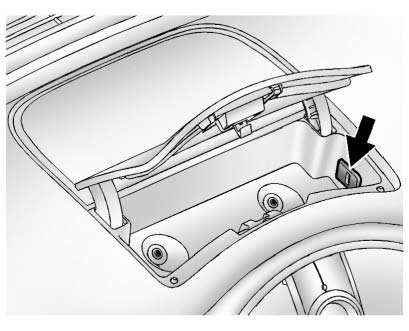
To connect a USB storage device, plug the device into the USB port located in the instrument panel storage area. See Instrument Panel Storage for more information.
The USB port can be used to control an iPod or a compatible USB storage device through the Buick Enclave audio system.
To connect an iPod, plug one end of the USB cable supplied with the iPod into the iPod dock connector, then connect the other end to the USB port in the instrument panel storage area.
If the vehicle is on and the USB connection is recognized, “OK to disconnect” and a GM logo may appear on the iPod. The word iPod also appears on the radio display.
Music stored on the iPod appears on the radio display and begins playing through the audio system.
The iPod charges while connected if the vehicle is in the ACC/ACCESSORY or ON/RUN position. When the vehicle is turned off, the iPod automatically powers off and does not continue charging or drawing power from the vehicle battery.
If an older iPod model is not supported through the USB connection, it can still be used by connecting it to the Auxiliary Input Jack with a standard 3.5 mm (1/8 in) stereo cable. See Auxiliary Devices for more information.
Using the Radio to Control a USB Storage Device or iPod
The radio can control a USB storage device or iPod by using the radio buttons, knobs, and display menus. When supported track data is available, song information appears on the radio display, allowing the driver or passenger to identify the current file more easily.
 (Tune): Turn this control to select files from the connected USB device or iPod.
 SEEK: Press to return to the start of the current track if more than 10 seconds have already played. Press and hold, or press repeatedly, to continue moving backward through tracks.
 SEEK: Press to move to the next track. Press and hold, or press several times, to continue moving forward through tracks.
 REV (Reverse): Press and hold to reverse quickly through the current track.
Audio is heard at a reduced volume while reverse search is active. Release
 REV to resume normal playback. The elapsed time of the file appears on the display.
 FWD (Fast Forward): Press and hold to advance quickly through the current track. Audio is heard at a reduced volume during fast forward. Release
 FWD to resume playback. The elapsed time of the file appears on the display.
 (Information): Press to display additional information about the selected track when that information is available.
Using Softkeys to Control a USB Storage Device or iPod
The five softkeys located below the radio display are used to control the USB storage device or iPod functions described below. These controls allow the Buick Enclave audio system to browse music, pause playback, move through folders, and select files without needing to handle the connected device directly.
To use the softkeys:
1. Press the first or fifth softkey below the radio display to show the available functions listed below, or press the softkey below a function if that function is already displayed.
2. Press the softkey below the tab that contains the desired function to activate it.
 (Pause): Press the softkey below
to pause the current track.
(Pause): Press the softkey below
to pause the current track.
The tab appears raised when pause is active. Press the softkey below
again to resume playback.
Back: Press the softkey below the Back tab to return to the main display screen when using an iPod, or to return to the root directory when using a USB storage device.
 (Folder View): Press the softkey
below
(Folder View): Press the softkey
below  to view the contents of the
current folder on the USB drive. To browse and select files:
to view the contents of the
current folder on the USB drive. To browse and select files:
1. Press the softkey below  .
.
2. Turn  to scroll through the list
of folders.
to scroll through the list
of folders.
3. Press  to select the folder.
If there is more than one folder level, repeat Steps 1 and 2 until the desired folder is reached.
4. Turn to scroll through the files
in the selected folder.
5. Press to select the file to be
played.
To move through large lists more quickly, the five softkeys can be used as shortcuts in the following order:
► First softkey: moves to the first item in the list.
► Second softkey: moves approximately 1% through the list each time it is pressed.
► Third softkey: moves approximately 5% through the list each time it is pressed.
► Fourth softkey: moves approximately 10% through the list each time it is pressed.
► Fifth softkey: moves to the end of the list.
 (Music Navigator): Press the softkey
below
(Music Navigator): Press the softkey
below  to view and select a file on
an iPod using the iPod menu system. Files can be sorted by:
to view and select a file on
an iPod using the iPod menu system. Files can be sorted by:
► Playlists
► Artists
► Albums
► Genres
► Songs
► Composers
To select files:
1. Press the softkey below  .
.
2. Turn  to scroll through the list
of menus.
to scroll through the list
of menus.
3. Press  to select the menu.
4. Turn to scroll through the folders
or files in the selected menu.
5. Press to select the file to be
played.
To move through long iPod lists more efficiently, the five softkeys can be used as quick navigation points in the following order:
► First softkey: moves to the first item in the list.
► Second softkey: moves approximately 1% through the list each time it is pressed.
► Third softkey: moves approximately 5% through the list each time it is pressed.
► Fourth softkey: moves approximately 10% through the list each time it is pressed.
► Fifth softkey: moves to the end of the list.
Repeat Functionality
To use Repeat:
Press the softkey below  or
or
 to choose between Repeat All and Repeat
Track.
to choose between Repeat All and Repeat
Track.
(Repeat All): Press the softkey
below to repeat all tracks.
The tab appears lowered when Repeat All is active. This is the default repeat mode when a USB storage device or iPod is first connected to the Buick Enclave audio system.
(Repeat Track): Press the softkey
below to repeat one track. The tab
appears raised when Repeat Track is active.
Shuffle Functionality
To use Shuffle:
Press the softkey below ,
,
 or
or
 to select between Shuffle Off, Shuffle
All Songs/ Shuffle Songs, Shuffle Album, or Shuffle Folder.
to select between Shuffle Off, Shuffle
All Songs/ Shuffle Songs, Shuffle Album, or Shuffle Folder.
 (Shuffle Off): This is the default
mode when a USB storage device or iPod is first connected.
(Shuffle Off): This is the default
mode when a USB storage device or iPod is first connected.
 (Shuffle All Songs/Shuffle Songs):
Shuffles all songs on the USB storage device or iPod so they play in a mixed order.
(Shuffle All Songs/Shuffle Songs):
Shuffles all songs on the USB storage device or iPod so they play in a mixed order.
 (Shuffle Album): Shuffles all songs
in the current album on an iPod.
(Shuffle Album): Shuffles all songs
in the current album on an iPod.
 (Shuffle Folder): Shuffles all songs
in the current folder on a USB storage device.
(Shuffle Folder): Shuffles all songs
in the current folder on a USB storage device.
