
Buick Enclave: General Towing Information. Driving Characteristics and Towing Tips. Trailer Towing
General Towing Information
Only use towing equipment that has been designed for the vehicle. The hitch, wiring, safety chains, trailer brakes, and related towing components must be compatible with the vehicle and the trailer being used. Proper equipment helps protect the vehicle and supports safer handling while towing.
Contact your dealer or trailering dealer for assistance with preparing the vehicle for towing a trailer. A properly prepared Buick Enclave should have the correct towing equipment, load distribution, electrical connection, and service checks completed before trailer use.
See the following trailer towing information in this section:
► For information on driving while towing a trailer, see “Driving Characteristics and Towing Tips.” . For maximum vehicle and trailer weights, see “Trailer Towing.” . For information on equipment to tow a trailer, see “Towing Equipment.”For information on towing a disabled vehicle, see Towing the Vehicle . For information on towing the vehicle behind another vehicle such as a motor home, see Recreational Vehicle Towing .
Towing changes the way a vehicle accelerates, turns, stops, and responds to road conditions. Added trailer weight can increase stopping distance, place more load on the engine and transmission, and require wider turns. Before towing with the Buick Enclave, review the towing limits and make sure the trailer load is properly balanced and secured.
Do not assume that available cargo space or engine power alone determines towing capability. Trailer weight, tongue weight, passenger weight, cargo weight, axle ratings, tire condition, and towing equipment all matter. Staying within the correct ratings helps maintain stability, braking performance, and long-term vehicle durability.
Driving Characteristics and Towing Tips
 WARNING
The driver can lose control when pulling a trailer if the correct equipment is
not used or the vehicle is not driven properly.
For example, if the trailer is too heavy, the brakes may not work well—or even at all. The driver and passengers could be seriously injured. The vehicle may also be damaged; the resulting repairs would not be covered by the vehicle warranty. Pull a trailer only if all the steps in this section have been followed. Ask your dealer for advice and information about towing a trailer with the vehicle.
The vehicle can tow a trailer when it is equipped with the proper trailer towing equipment. For trailering capacity, see Trailer Towing . Before towing, it is important to understand that a trailer changes the way the vehicle feels and responds. Acceleration will be slower, braking distance will be longer, turns will require more space, and fuel economy will usually decrease.
Trailering also affects durability. With the added weight, the engine, transmission, wheel assemblies, brakes, suspension components, and tires must work harder and operate under greater load. The trailer adds wind resistance as well, which increases the effort required to maintain speed, especially on highways, hills, and in windy conditions. For safe trailering in the Buick Enclave, always use the correct towing equipment and stay within the approved ratings.
The following information contains important trailering tips and rules for the safety of the driver, passengers, and others on the road. Read this section carefully before pulling a trailer, even if you have towing experience with another vehicle.
Pulling a Trailer
Here are some important points:
► There are many laws, including speed limit restrictions, that apply to trailering. Check the legal requirements for the areas where you will be driving. Trailer laws can include speed limits, lighting rules, brake requirements, mirror requirements, weight limits, and lane restrictions. ► Consider using sway control.See Towing Equipment . Trailer sway can be affected by speed, wind, passing trucks, road surface, load balance, and improper tongue weight. The correct equipment can help improve stability when towing.
► Do not tow a trailer at all during the first 800 km (500 miles) the new vehicle is driven.The engine, axle, transmission, brakes, or other parts could be damaged if a trailer is pulled too early in the break-in period. Allow the vehicle components to settle into normal operation before placing extra towing load on them.
► During the first 800 km (500 miles) that a trailer is towed, do not drive over 80 km/h (50 mph) and do not make starts at full throttle. This reduces wear on the vehicle and helps the powertrain, brakes, and related components adjust to trailering loads more gradually. ► The vehicle can tow in D (Drive).Use a lower gear if the transmission shifts too often. Frequent shifting can indicate that the transmission is working hard to maintain speed, especially on hills, in headwinds, or with a heavier trailer.
See “Tow/Haul Mode” later in this section.
► Obey speed limit restrictions when towing a trailer. Driving too fast while towing can reduce stability, increase stopping distance, and make trailer sway more difficult to control. ► The vehicle is designed primarily as a passenger and load carrying vehicle. If a trailer is towed, the vehicle will require more frequent maintenance due to the additional load.When towing with the Buick Enclave, plan trips more carefully than usual. Allow more time for acceleration, choose fuel stops with enough room to maneuver, avoid sudden lane changes, and leave extra space from the vehicle ahead. Smooth driving helps reduce stress on both the vehicle and trailer.
Driving with a Trailer
Towing a trailer requires experience. Even a properly equipped vehicle will feel different when a trailer is attached. The added length, weight, and movement of the trailer affect steering response, braking, acceleration, lane changes, and backing.
Get familiar with handling and braking with the added trailer weight before driving in heavy traffic or at highway speeds. The vehicle is now longer and not as responsive as the vehicle is by itself. Practice turning, stopping, reversing, and parking in an open area if you are not used to towing.
Check all trailer hitch parts and attachments, safety chains, electrical connectors, lamps, tires, and mirror adjustments. If the trailer has electric brakes, start the vehicle and trailer moving and then apply the trailer brake controller by hand to be sure the brakes are working. This check should be done before entering traffic.
During the trip, check regularly to be sure that the load is secure, and the lamps and trailer brakes are working properly. Cargo inside the trailer can shift while driving, which may change trailer balance and increase sway. Stop safely and inspect the trailer if it begins to feel unstable or if unusual movement is noticed.
Because the Buick Enclave will need more space when towing, begin braking earlier than normal and make wider turns. Watch the trailer wheels in turns to avoid curbs, shoulders, signs, posts, and parked vehicles. Use mirrors often and avoid sudden steering corrections.
Towing with a Stability Control System
When towing, the sound of the stability control system might be heard. The system is reacting to vehicle movement caused by the trailer, which mainly occurs during cornering. This is normal when towing heavier trailers.
The stability control system can help respond to certain vehicle movements, but it cannot overcome an overloaded trailer, poor weight distribution, unsafe speed, improper equipment, or low tire pressure. If the system activates frequently while towing, reduce speed and check that the trailer is loaded correctly.
Trailer stability begins with proper preparation. Make sure the load is balanced, the tongue weight is correct, the tires are properly inflated, and all hitch components are securely fastened before driving.
Tow/Haul Mode
Tow/Haul assists when pulling a heavy trailer or carrying a large or heavy load. The purpose of the Tow/Haul mode is to change transmission and vehicle operation so the Buick Enclave feels more controlled when extra weight is being moved.
► Reduce the frequency and improve the predictability of transmission shifts.► Provide the same solid shift feel as when the vehicle is unloaded. ► Improve control of vehicle speed while requiring less throttle pedal activity.
► Increase the charging system voltage to assist in recharging a battery installed in a trailer.

Press this button located on the console to turn on and turn off the Tow/Haul mode. See Tow/Haul Mode .
The Tow/Haul light on the instrument panel comes on to indicate that Tow/Haul mode has been selected. This lets the driver confirm that the system is active before towing or driving with a heavy load.
Tow/Haul may be turned off by pressing the button again, at which time the indicator light on the instrument panel will turn off.
The vehicle will automatically turn off Tow/Haul every time it is started. If Tow/Haul is needed for the next trip, it must be selected again after starting the vehicle.
Tow/Haul is designed to be most effective when the vehicle and trailer combined weight is at least 75 percent of the vehicle's Gross Combined Weight Rating (GCWR).
See Trailer Towing .
Tow/Haul is most useful when pulling a heavy trailer or a large or heavy load under the following driving conditions:
► Traveling through rolling terrain. ► Traveling in stop and go traffic. ► Traveling in busy parking lots where improved low speed control of the vehicle is desired.Using Tow/Haul at the right time can make towing feel smoother and more predictable. It can help the transmission hold gears more appropriately, reduce unnecessary shifting, and give the driver better control during low-speed movement, hill driving, and repeated acceleration and braking.
Tow/Haul does not increase the maximum trailer weight or payload capacity of the Buick Enclave. The driver must still stay within all weight ratings, use proper equipment, secure the trailer correctly, and adjust driving style for the added load.
Operating the vehicle in Tow/Haul when it is lightly loaded or when no trailer is attached will not cause damage, but it normally provides no real benefit. In these conditions, Tow/Haul may make the engine and transmission feel less smooth during everyday driving, and fuel economy may be reduced because the shift pattern is intended for heavier loads.
For normal driving without a trailer or significant cargo weight, D (Drive) is usually the better choice. Use Tow/Haul when the Buick Enclave is pulling a trailer, carrying a heavy load, or operating in conditions where the transmission would benefit from more deliberate shift control.
Following Distance
Stay at least twice as far behind the vehicle ahead as you would when driving without a trailer. A trailer adds weight and length, so the vehicle needs more space to slow down, stop, and react safely to traffic changes.
This extra distance can help avoid situations that require heavy braking, sudden lane changes, or sharp steering. It also gives the driver more time to see brake lights, road hazards, traffic signals, and vehicles entering the lane ahead.
When towing with the Buick Enclave, following distance should be adjusted even more in rain, snow, wind, heavy traffic, downhill grades, or on roads with poor surface conditions. Smooth and early braking is safer than waiting until the last moment.
Passing
More passing distance is needed when towing a trailer. Because the complete vehicle and trailer combination is longer and heavier, acceleration takes more time and the driver must travel farther beyond the passed vehicle before returning to the lane.
Before passing, make sure there is enough clear road, legal passing space, and time to complete the maneuver without rushing. Avoid passing on hills, curves, narrow roads, or in areas where traffic can change quickly. After passing, allow extra room before moving back into the lane so the trailer clears the other vehicle safely.
Backing Up
Hold the bottom of the steering wheel with one hand. To move the trailer to the left, move that hand to the left. To move the trailer to the right, move your hand to the right. Always back up slowly and, if possible, have someone guide you.
Backing with a trailer requires patience because the trailer reacts differently than the vehicle alone. Small steering corrections are usually better than large ones. If the trailer begins to turn too sharply, stop, pull forward to straighten the combination, and try again.
Use mirrors carefully and keep the guide person visible whenever possible. The guide should stand where they can see the trailer path clearly but remain out of the path of the vehicle and trailer. Never back up faster than you can safely stop.
Making Turns
Notice: Making very sharp turns while trailering could cause the trailer to come in contact with the vehicle. The vehicle could be damaged. Avoid making very sharp turns while trailering.
When turning with a trailer, make wider turns than normal so the trailer will not strike soft shoulders, curbs, road signs, trees, parked vehicles, fuel pumps, posts, or other objects. A trailer follows a tighter path than the vehicle, so the trailer wheels can cut inside the turn.
Use the turn signal well in advance and avoid jerky or sudden maneuvers. Begin turns slowly, keep the vehicle and trailer aligned smoothly, and allow enough space for the rear of the trailer to clear nearby obstacles.
In tight areas such as parking lots, campgrounds, boat ramps, or fuel stations, move slowly and watch both sides of the trailer. A careful turn protects the Buick Enclave, the trailer, and surrounding property from contact damage.
Turn Signals When Towing a Trailer
The turn signal indicators on the instrument panel flash whenever signaling a turn or lane change.
When the trailer wiring is properly connected, the trailer lamps also flash, telling other drivers that the vehicle is turning, changing lanes, or stopping. Working trailer lamps are essential because drivers behind the trailer may not be able to see the vehicle’s rear lights clearly.
When towing a trailer, the arrows on the instrument panel flash for turns even if the bulbs on the trailer are burned out. Check occasionally to be sure the trailer bulbs are still working.
Before each towing trip, inspect the brake lamps, turn signals, hazard lamps, and running lamps on the trailer. A quick light check can help prevent unsafe driving, traffic violations, and confusion for other drivers.
Driving on Grades
Reduce speed and shift to a lower gear before starting down a long or steep downgrade. If the transmission is not shifted down, the brakes might have to be used so much that they could become hot and no longer work well. See “Automatic Engine Grade Braking” within Tow/Haul Mode .
The vehicle can tow in D (Drive).
Use a lower gear if the transmission shifts too often. Repeated shifting can create extra heat and may indicate that the vehicle is working hard to maintain speed under load.
When towing at high altitude on steep uphill grades, engine coolant will boil at a lower temperature than at normal altitudes. If the engine is turned off immediately after towing at high altitude on steep uphill grades, the vehicle may show signs similar to engine overheating.
To help avoid this, let the engine run while parked, preferably on level ground, with the transmission in P (Park) for a few minutes before turning the engine off. This allows the cooling system to stabilize after heavy towing demand. If the overheat warning comes on, see Engine Overheating .
On a long uphill grade, shift down and reduce the vehicle speed to around 88 km/h (55 mph) to reduce the possibility of the engine and the transmission overheating.
Grade driving with a trailer requires planning. Watch temperature warnings, maintain a reasonable speed, avoid full-throttle operation for long periods, and leave enough room for slower traffic. In the Buick Enclave, careful gear selection and moderate speed help reduce heat buildup and make towing on hills more controlled.
Parking on Hills
WARNING
Parking the vehicle on a hill with the trailer attached can be dangerous. If
something goes wrong, the rig could start to move.
People can be injured, and both the vehicle and the trailer can be damaged. When possible, always park the rig on a flat surface.
Parking on a flat surface is always preferred when towing. A vehicle and trailer combination places more load on the parking brake, transmission parking mechanism, tires, and wheel chocks. If a flat area is available, use it instead of parking on a slope.
If parking the rig on a hill:
1. Press the brake pedal, but do not shift into P (Park) yet.
Turn the wheels into the curb if facing downhill or into traffic if facing uphill.
2. Have someone place chocks under the trailer wheels.
3. When the wheel chocks are in place, release the brake pedal until the chocks absorb the load.
4. Reapply the brake pedal.
Then apply the parking brake and shift into P (Park).
5. Release the brake pedal.
This sequence helps transfer the weight of the trailer to the chocks before the vehicle is fully placed in Park. Using the correct order reduces stress on the parking mechanism and helps keep the vehicle and trailer from moving unexpectedly.
Leaving After Parking on a Hill
1. Apply and hold the brake pedal while you:
1.1. Start the engine.
1.2. Shift into a gear.
1.3. Release the parking brake.
2. Let up on the brake pedal.
3. Drive slowly until the trailer is clear of the chocks.
4. Stop and have someone pick up and store the chocks.
When leaving a hill, move slowly and avoid sudden throttle input. Make sure the trailer has cleared the chocks completely before stopping to retrieve them. The person removing the chocks should stay clear of the trailer wheels and should not stand in the path of the vehicle or trailer.
Maintenance When Trailer Towing
The vehicle needs service more often when pulling a trailer. Towing places additional demand on many systems, so regular inspection becomes more important than during normal unloaded driving.
See Maintenance Schedule . Things that are especially important in trailer operation are automatic transmission fluid, engine oil, axle lubricant, belts, cooling system, and brake system. Inspect these before and during the trip.
Check periodically to see that all hitch nuts and bolts are tight. Also inspect safety chains, trailer wiring, trailer brakes, tires, wheel bearings, and load tie-downs. A small problem can become serious during a long towing trip if it is not found early.
For the Buick Enclave, proper towing maintenance helps protect the transmission, cooling system, brakes, tires, and suspension. If the vehicle is used for frequent towing, severe-duty service intervals may apply, and the vehicle should be inspected more often.
Engine Cooling When Trailer Towing
The cooling system may temporarily overheat during severe operating conditions. See Engine Overheating .
Severe towing conditions can include high outside temperatures, steep grades, high altitude, stop-and-go traffic, heavy trailer weight, strong headwinds, or long periods of low-speed operation. If the temperature begins to rise, reduce speed, turn off unnecessary electrical loads, and find a safe place to stop if warnings appear.
Do not ignore signs of overheating while towing. Continuing to drive with an overheated engine or transmission can cause serious damage. Allow the vehicle to cool as directed in the proper section, and have the system inspected if overheating happens repeatedly.
Trailer Towing
Three important weight-related factors must be considered before towing. These are not separate details to check casually; they work together and determine whether the trailer combination can be operated safely, legally, and without placing excessive strain on the vehicle.
► The weight of the trailer► The weight of the trailer tongue
► The total weight on the vehicle's tires
For the Buick Enclave, proper towing preparation begins with understanding these three limits. A trailer may appear suitable by size, but if the loaded trailer weight, tongue weight, or tire loading is too high, the vehicle can become harder to control and mechanical components can be overloaded.
Weight of the Trailer
How heavy can a trailer safely be?
The answer depends on more than the trailer alone. Speed, altitude, road grades, outside temperature, special equipment, and the amount of tongue weight the vehicle can carry must all be considered. See “Weight of the Trailer Tongue” later in this section for more information.
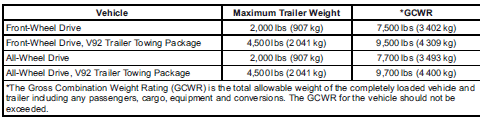
Maximum trailer weight is calculated assuming only the driver is in the tow vehicle and it has all the required trailering equipment. This means the published maximum is not automatically available in every real-world situation.
The weight of additional optional equipment, passengers, and cargo in the tow vehicle must be subtracted from the maximum trailer weight. Every passenger, suitcase, tool box, cooler, cargo carrier, or added accessory reduces the amount of trailer weight the vehicle can safely handle.
Use the following chart to determine how much the vehicle can weigh, based upon the vehicle model and options. The correct rating should always be matched to the exact vehicle configuration, not estimated from another model or from a similar-looking vehicle.
Ask your dealer for our trailering information or advice.
See Customer Assistance Offices (U.S. and Canada) or Customer Assistance Offices (Mexico) for more information.
Before towing, weigh the loaded trailer if possible. The actual loaded weight can be much higher than the empty trailer weight, especially after adding cargo, water, fuel, tools, camping equipment, or recreational gear. Knowing the real weight helps prevent overloading and improves towing safety.
Weight of the Trailer Tongue
The tongue load (A) of any trailer is an important weight to measure because it affects the total gross weight of the vehicle. The Gross Vehicle Weight (GVW) includes the curb weight of the vehicle, any cargo carried in it, and the people who will be riding in the vehicle.
If there are many options, equipment items, passengers, or cargo in the vehicle, this reduces the tongue weight the vehicle can carry, which also reduces the trailer weight the vehicle can tow. If towing a trailer, the tongue load must be added to the GVW because the vehicle will be carrying that weight too. See Vehicle Load Limits
Tongue weight has a major effect on trailer stability. Too little tongue weight can allow trailer sway, while too much tongue weight can overload the rear axle, reduce steering feel, and change the way the vehicle sits and handles. Proper balance is especially important when the Buick Enclave is carrying passengers and luggage at the same time as towing.
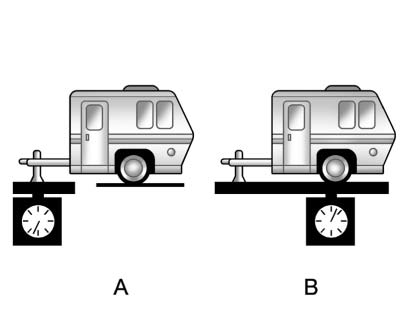
If a weight-carrying hitch or a weight-distributing hitch is being used, the trailer tongue (A) should weigh 10-15 percent of the total loaded trailer weight (B).
After loading the trailer, weigh the trailer and then the tongue separately to see if the weights are proper. If they are not, adjustments might be made by moving some items around in the trailer. Heavy items should generally be placed low and secured so they cannot shift while driving.
Trailering may be limited by the vehicle's ability to carry tongue weight. Tongue weight cannot cause the vehicle to exceed the GVWR (Gross Vehicle Weight Rating) or the RGAWR (Rear Gross Axle Weight Rating). The effect of additional weight may reduce the trailering capacity more than the total of the additional weight.
It is important that the vehicle does not exceed any of its ratings — GCWR, GVWR, RGAWR, Maximum Trailer Rating, or Tongue Weight. The only reliable way to be sure it is not exceeding any of these ratings is to weigh the vehicle and trailer.
Do not rely only on how the vehicle looks after the trailer is attached. A vehicle may appear level and still exceed one of its ratings. A public scale, weigh station, or qualified towing professional can help confirm the actual loaded condition.
Total Weight on the Vehicle's Tires
Inflate the vehicle's tires to the upper limit for cold tires. These numbers can be found on the Certification label, or see Vehicle Load Limits for more information. Tire pressure should be checked when the tires are cold, before long driving or heavy towing heat builds up in the tires.
Do not go over the GVW limit for the vehicle, or the GAWR, including the weight of the trailer tongue. If using a weight distributing hitch, do not go over the rear axle limit before applying the weight distribution spring bars.
Tires carry the actual load placed on the vehicle, so correct inflation and proper load limits are critical. Underinflated tires can overheat, wear unevenly, reduce stability, and increase the risk of tire failure. Before towing with the Buick Enclave, inspect tire condition, tread depth, sidewalls, and pressure on both the vehicle and the trailer.
Trailer loading should be checked again whenever cargo changes. Adding supplies, moving heavy equipment, filling tanks, or carrying additional passengers can change the load on the vehicle tires and axles.
