Buick Enclave: Description and Operation
ALL SEASONS TIRES DESCRIPTION
All-season tires are designed to provide balanced performance across a wide range of normal driving conditions, including dry pavement, rain, and light snow. They are not the same as dedicated winter tires, but their tread pattern and compound are developed to offer better cold-weather and snow traction than older non-all-season radial tire designs.
Fig. 22: Identifying All Seasons Tire Marking
Most GM vehicles are equipped with steel belted all-season radial tires as standard equipment. These tires qualify as snow tires, with a higher than average rating for snow traction than the non-all season radial tires previously used. Other performance areas, such as wet traction, rolling resistance, tread life and air retention, are also improved. This is done by improvements in both tread design and tread compounds. These tires are identified by an M + S molded in the tire side wall after the tire size. The suffix MS is also molded in the tire side wall after the TPC specification number.
For the Buick Enclave, the M + S marking is a quick way to identify that the tire has been designed for mud and snow capability within the limits of an all-season tire. The marking should not be used as the only factor when selecting replacement tires; the tire size, load rating, speed rating, construction, and TPC specification should also match the required application.
The optional handling tires used on some vehicles now also have the MS marking after the tire size and the TPC specification number.
Handling-oriented tires with an MS marking may still have different ride, noise, traction, and treadwear characteristics than standard touring all-season tires. When replacing tires, compare the complete tire specification rather than assuming that the MS marking alone confirms the same performance behavior.
GENERAL DESCRIPTION
The factory installed tires are designed to operate satisfactorily with loads up to and including the full rated load capacity when these tires are inflated to the recommended pressures.
Correct inflation is the foundation of tire performance. A tire that is underinflated, overinflated, overloaded, or unevenly worn cannot deliver the same handling, braking, and ride quality intended by the vehicle manufacturer. Tire condition should be inspected as part of routine service and whenever the customer reports vibration, pulling, tire noise, poor ride quality, or abnormal tread wear.
The following factors have an important influence on tire life:
- Correct tire pressures
- Correct wheel alignment
- Proper driving techniques
- Tire rotation
These factors work together. Correct pressure helps the tread contact the road evenly, alignment keeps the tire tracking straight, rotation balances wear between axle positions, and smooth driving reduces unnecessary heat and tread stress.
The following factors increase tire wear:
- Heavy cornering
- Excessively rapid acceleration
- Heavy braking
Aggressive driving can accelerate shoulder wear, center tread wear, feathering, and heat buildup. If tire wear appears excessive for the mileage, inspect both the mechanical condition of the vehicle and the operating conditions that may be contributing to the wear pattern.
METRIC WHEEL NUTS AND BOLTS DESCRIPTION
Metric wheel/nuts and bolts are identified in the following way:
- The wheel/nut has the word Metric stamped on the face.
- The letter M is stamped on the end of the wheel bolt.
The thread sizes of metric wheel/nuts and the bolts are indicated by the following example: M12 x 1.5.
- M = Metric
- 12 = Diameter in millimeters
- 1.5 = Millimeters gap per thread
Wheel fasteners must match the correct thread size, seat design, length, and strength rating. Incorrect wheel nuts or bolts may appear to fit at first, but they can damage the threads, clamp the wheel unevenly, distort the mounting seat, or loosen after driving. Always verify the fastener type before installation, especially if wheels or hardware have been replaced previously.
P-METRIC SIZED TIRES DESCRIPTION
Fig. 23: Identifying P-Metric Sized Tire Marking
Replacement tires should be of the same tire performance criteria (TPC) specification number. This will ensure the same size, the same load range and the same construction as those originally installed on the vehicle.
The P-metric tire size marking provides tire type, section width, aspect ratio, construction, wheel diameter, and other service information. Matching the TPC specification is important because two tires with the same basic size may still differ in load capacity, tread design, rolling resistance, ride quality, sidewall stiffness, and handling response. On the Buick Enclave, using tires with the correct specification helps maintain intended ride comfort, traction, steering feel, and tire pressure monitoring accuracy.
REPLACEMENT WHEELS DESCRIPTION
Replace the wheel if any of the following conditions exist:
- The wheel exhibits excessive runout.
- The wheel is bent.
- The wheel is cracked.
- The wheel is severely rusted.
- The wheel is severely corroded.
- The wheel leaks air.
A damaged wheel can cause more than a cosmetic issue. Excessive runout may lead to vibration, uneven tire wear, brake pulsation complaints, and difficulty balancing the assembly. Cracks, severe corrosion, or air leaks can affect tire retention and should not be ignored during tire and wheel service.
NOTE: Air leaks caused by porosity on aluminum wheels are repairable.
WARNING: If you are replacing the wheel(s), the wheel stud(s), the wheel nut(s) or the wheel bolt(s), install only new GM original equipment parts.
Installation of used parts or non-GM original equipment parts may cause the wheel to loosen, loss of tire air pressure, poor vehicle handling and loss of vehicle control resulting in personal injury.
CAUTION: The use of non-GM original equipment wheels may cause:
- Damage to the wheel bearing, the wheel fasteners and the wheel
- Tire damage caused by the modified clearance to the adjacent vehicle components
- Adverse vehicle steering stability caused by the modified scrub radius
- Damage to the vehicle caused by the modified ground clearance
- Speedometer and odometer inaccuracy
Wheel design affects load path, bearing stress, brake clearance, tire-to-body clearance, scrub radius, and speedometer calibration. A wheel that looks similar may still have the wrong offset, center bore, width, mounting seat, or load capacity. For Buick Enclave tire and wheel service, replacement wheels should be verified by application, part identification, and specification rather than appearance alone.
Replace the wheel, the wheel studs and the wheel/nuts or the wheel bolts if applicable, if any of the following conditions exist:
- The wheel has elongated bolt holes.
- The wheel/nuts or bolts if applicable, loosen repeatedly.
Elongated bolt holes or repeated loosening indicate that the wheel may no longer clamp safely to the hub. Do not attempt to correct this condition by simply tightening the fasteners harder, because excessive torque can stretch the studs, damage the wheel seats, and create a more serious attachment concern.
Steel wheel identification is stamped into the wheel near the valve stem.
Aluminum wheel identification is cast into the inboard side of the wheel.
Use these identification marks to confirm that the wheel matches the correct vehicle application. If the identification is missing, unreadable, or does not match the intended part, verify the wheel through service information before installing it.
STEEL WHEEL REPAIR DESCRIPTION
CAUTION: Do not heat wheels in an attempt to soften them for straightening or repair damage from striking curbs, etc. Do not weld wheels. The alloy used in these wheels is heat-treated and uncontrolled heating from welding affects the properties of the material.
CAUTION: The use of tubes in tubeless tires is not a recommended repair due to the fact that speed ratings are greatly reduced.
You can repair porosity in aluminum wheels. If leaks are found in a steel wheel, replace the wheel with a wheel of original equipment quality.
Steel wheels that are cracked, leaking, severely bent, or structurally damaged should be replaced rather than heated, welded, or straightened with uncontrolled force. Repairs that alter the material or wheel shape can weaken the wheel and may create vibration, air loss, or unsafe wheel retention during driving.
TIRE INFLATION DESCRIPTION
When you inflate the tires to the recommended inflation pressures, the factory-installed wheels and tires are designed in order to handle loads to the tire's rated load capacity. Incorrect tire pressures or under-inflated tires, can cause the following conditions:
- Vehicle handling concerns
- Poor fuel economy
- Shortened tire life
- Tire overloading
Tire pressure should be treated as a service item, not only as a warning lamp concern. Underinflation increases heat and sidewall flex, while overinflation reduces ride comfort and can concentrate wear near the center of the tread. Correct pressure helps the Buick Enclave maintain predictable steering, braking, load carrying, and tire life.
Inspect the tire pressure when the following conditions apply:
- The vehicle has been sitting at least 3 hours.
- The vehicle has not been driven for more than 1.6 km (1 mi).
- The tires are cool.
Cold tire pressure is the most reliable reference because driving heats the tire and temporarily raises the pressure. If pressure is adjusted after the vehicle has been driven, the reading may not represent the true cold inflation value.
Inspect the tires monthly or before any extended trip. Adjust the tire pressure to the specifications on the tire label. Install the valve caps or the extensions on the valves. The caps or the extensions keep out dust and water.
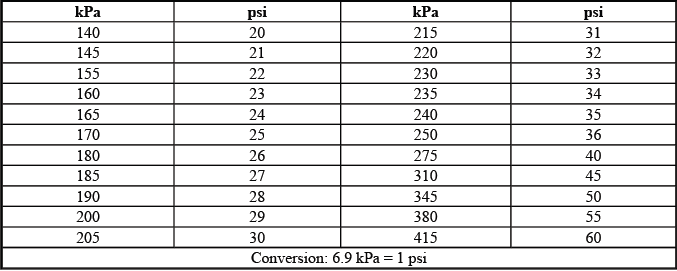
The kilopascal (kPa) is the metric term for pressure. The tire pressure may be printed in both kilopascal (kPa) and psi. One psi equals 6.9 kPa.
Inflation Pressure Conversion (Kilopascals to PSI)
Tires with a higher than recommended pressure can cause the following conditions:
- A hard ride
- Tire bruising
- Rapid tread wear at the center of the tire
Overinflation can make the tire less able to absorb road impact and may increase the chance of impact damage from potholes or sharp road edges. It can also reduce the size of the tire contact patch, which may affect traction and ride quality.
Tires with a lower than recommended pressure can cause the following conditions:
- A tire squeal on turns
- Hard steering
- Rapid wear and uneven wear on the edge of the tread
- Tire rim bruises and tire rim rupture
- Tire cord breakage
- High tire temperatures
- Reduced vehicle handling
- High fuel consumption
- Soft riding
Underinflation is especially damaging because it allows the sidewall and tread shoulders to flex excessively. This creates heat, increases rolling resistance, and can lead to internal tire damage before the outside of the tire shows an obvious problem.
Unequal pressure on the same axle can cause the following conditions:
- Uneven braking
- Steering lead
- Reduced vehicle handling
Unequal side-to-side pressure can make the vehicle drift, brake unevenly, or feel unstable during cornering. Always adjust pressures on all four tires as a set and then recheck any tire that continues to lose air.
Refer to the Tire Placard for specific tire and wheel applications and tire pressures.
TREAD WEAR INDICATORS DESCRIPTION
Fig. 24: View Of Tread Wear Indicators
The original equipment tires have tread wear indicators that show when you should replace the tires.
The location of these indicators are at 60º intervals around the outer diameter of the tire. The indicators appear as a 6 mm (0.25 in) wide band when the tire tread depth becomes 1.6 mm (2/32 in).
Tread wear indicators are a final replacement warning, not a target for normal service planning. Tires with uneven wear, sidewall damage, exposed cords, cracking, bulges, puncture damage, or poor wet traction may need replacement before the indicators become flush with the tread surface. Inspect the full tread width and both sidewalls during routine service.
SPECIAL TOOLS AND EQUIPMENT
SPECIAL TOOLS
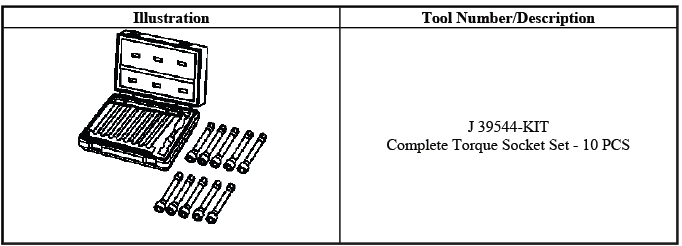
Special tire and wheel tools are used to measure, service, repair, and inspect wheel assemblies without damaging the tire bead, wheel finish, TPMS sensor, or mounting surfaces. Using the correct equipment helps prevent repeat vibration, air loss, and wheel attachment concerns after service.