Buick Enclave: Description and Operation
FRONT SUSPENSION DESCRIPTION AND OPERATION
The front suspension has 2 primary purposes:
- Isolate the driver and passengers from irregularities in the road surface.
- Define the ride quality, steering response, and handling characteristics of the vehicle.
The front suspension absorbs the impact created when the tires travel over bumps, dips, broken pavement, and other road surface irregularities. Instead of allowing the full impact to pass directly into the body structure, the suspension spreads and controls that energy through the tires, wheels, control arms, bushings, coil springs, struts, stabilizer shaft, and related mounting points. This process helps keep the occupants isolated from harsh road inputs while maintaining tire contact with the road.
The way the suspension absorbs and releases energy determines much of the vehicle’s ride character. The amount of movement allowed, the spring rate, the damping force, the bushing stiffness, and the stabilizer shaft design are all engineered into the suspension system. These ride characteristics are built into the vehicle and are not normally adjustable. They are described here to make the function of the front suspension easier to understand. The suspension must allow vertical travel of the tire and wheel assembly while still keeping the tire positioned correctly in relation to the road surface.
To accomplish this, the steering knuckle is supported between the lower control arm and the strut assembly. The outer end of the lower control arm attaches to the steering knuckle through a ball and socket type joint. The inner end of the lower control arm attaches to the vehicle frame at 2 points through semi-rigid bushings. These bushings allow controlled movement while helping isolate vibration and road noise. The upper portion of the steering knuckle attaches to the strut assembly, which gives the knuckle a controlled path of movement as the suspension travels.
The strut assembly connects to the vehicle body through an upper bearing and mount. This arrangement allows the steering knuckle to move up and down independently from the body and frame structure while still maintaining steering control. On the Buick Enclave, this layout helps combine ride comfort with predictable handling, especially during braking, cornering, and driving over uneven road surfaces.
The up and down motion of the steering knuckle as the vehicle travels over bumps is absorbed mainly by the coil spring. The coil spring is retained under tension around the strut assembly and supports vehicle weight while allowing suspension travel. A strut is used with the spring to dampen the spring’s oscillations. Without damping, the spring would continue to rebound after a road impact, causing excessive bounce and poor tire control.
The strut is a hydraulic damping unit. It is filled with oil and contains a moveable shaft connected to a piston inside the strut body. Valves inside the strut create resistance to oil flow. This resistance slows the movement of the piston and shaft, which reduces rapid suspension movement and helps control body motion. A properly working strut keeps the tire more stable against the road and helps reduce nose dive, bounce, and vibration.
Each end of the strut is designed to serve as a structural connection point in the suspension system. The strut also acts as a seat and support for the coil spring. This design allows the strut to control the rebound and compression action of the spring while also helping position the steering knuckle. The lower control arm pivots vertically at the vehicle frame, and the ball joint allows the steering knuckle to maintain the correct relationship to the road surface during steering and suspension movement.
Front suspension systems also use a stabilizer shaft. The stabilizer shaft connects the left and right sides of the suspension through the stabilizer links and stabilizer shaft insulators. When the vehicle turns, the stabilizer shaft resists excessive independent movement between the left and right control arm assemblies. By limiting body roll and helping balance side-to-side suspension movement, the stabilizer shaft plays an important role in how the Buick Enclave feels during cornering, lane changes, and uneven road transitions.
When diagnosing front suspension concerns, always consider the system as a complete assembly rather than a single part. A clunk, rattle, pull, vibration, uneven tire wear, or loose steering feel may be caused by a worn bushing, weak strut, damaged ball joint, loose stabilizer link, shifted frame component, bearing concern, or alignment issue. Careful inspection of each connection point helps identify the actual source of the problem before parts are replaced.
SPECIAL TOOLS AND EQUIPMENT
SPECIAL TOOLS
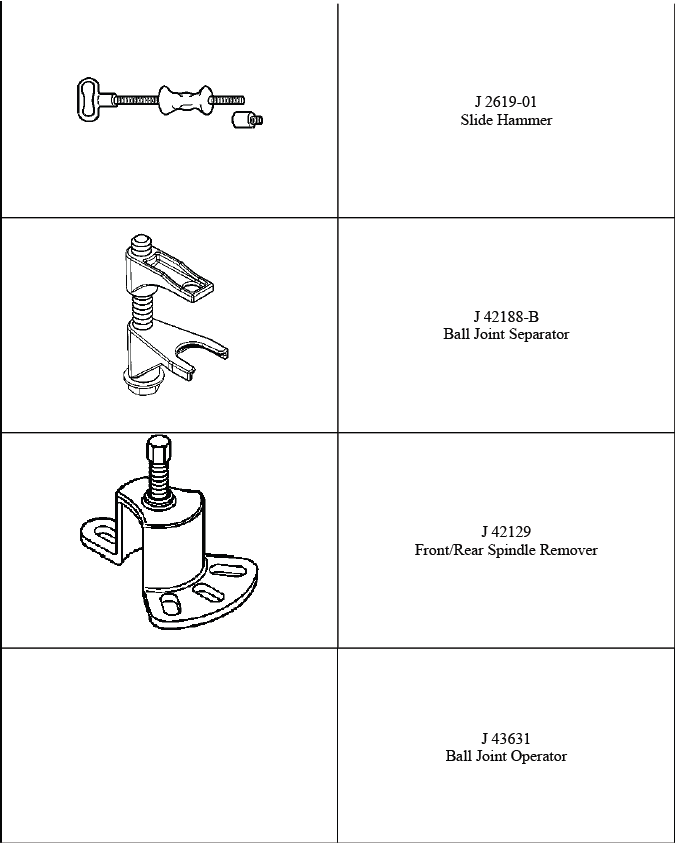
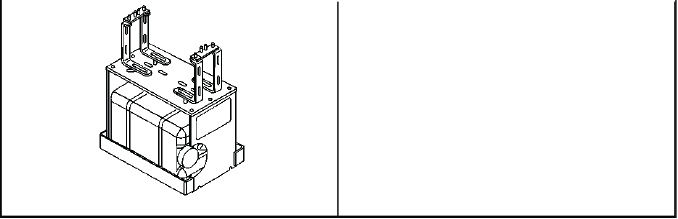
The following special tools support front suspension service, including control arm, ball joint, bushing, wheel hub, strut, and stabilizer component procedures. Using the correct tool helps prevent damage to suspension mounting points, rubber bushings, steering knuckles, hub assemblies, and spring-loaded components during repair.