Buick Enclave: Description and Operation
STEERING WHEEL AND COLUMN DESCRIPTION AND OPERATION
The steering wheel and column assembly performs 4 primary functions. It provides the driver’s direct steering input, supports theft-deterrent features on equipped vehicles, carries several convenience controls, and contributes to driver protection during a collision. Because these functions overlap, service work around the column should be handled carefully, especially when electrical connectors, SIR-related components, or steering shaft connections are involved.
- Vehicle steering
- Vehicle security
- Driver convenience
- Driver safety
Vehicle Steering
The steering wheel is the first mechanical link between the driver and the vehicle. The steering wheel is fastened to a steering shaft inside the column. At the lower end of the column, the intermediate shaft connects the column to the steering gear, transferring driver input from the wheel to the steering system. On the Buick Enclave, correct alignment and secure connection of these components are essential for smooth steering feel and accurate steering response.
Vehicle Security, found on Some Vehicle Models
Theft deterrent components may be built into the steering column, depending on vehicle equipment. These components are designed to limit unauthorized operation by allowing the column or ignition system to be locked when the vehicle is parked. The following components allow the column to be locked in order to minimize theft:
- The ignition switch
- The steering column lock
- The ignition cylinder
Driver Convenience
The steering wheel and column may also support driver controls that improve comfort and ease of use. These controls are placed where the driver can reach them without taking attention away from the road. The following controls may be mounted on or near the steering wheel or column.
- The turn signal switch
- The hazard switch
- The headlamp dimmer switch
- The wiper/washer switch
- The horn pad/cruise control switch
- The redundant radio/entertainment system controls
- The tilt or tilt/telescoping functions
- The navigation/OnStar features
- The HVAC controls
Driver Safety
The energy-absorbing steering column is designed to compress in the event of a front-end collision, helping reduce the chance of injury to the driver. The mounting capsules are designed to break away from the mounting bracket during an accident. After a collision, the steering column should be inspected carefully for capsule movement, jacket collapse, looseness, binding, or any sign that the column absorbed impact energy.
Ignition Lock Cylinder Control Actuator
If the vehicle is equipped with a floor mounted console gear shift, it has an ignition lock cylinder control actuator system in the steering column. The purpose of the ignition lock cylinder control actuator is to prevent the ignition key from being turned to the OFF position when the transmission is in gear and the vehicle may still be moving.
The column ignition lock system consists of an ignition lock cylinder control actuator and a park position switch located in the A/T shift lock control switch. The ignition lock cylinder control actuator contains a spring-loaded pin that mechanically prevents the ignition key cylinder from being turned to the lock position when the transmission is not in Park. If vehicle power is lost, and/or the transmission is not in the Park position, the operator will not be able to turn the ignition key to the lock position and will not be able to remove the ignition key from the column. This design helps prevent key removal while the vehicle is not fully secured in Park.
STEERING WHEEL CONTROLS DESCRIPTION AND OPERATION (POWER TILT AND TELESCOPE)
Tilt/Telescoping Switch Operation
The tilt/telescoping steering column uses a four-position switch to adjust the steering wheel position. The column can move in or out for telescope adjustment and up or down for tilt adjustment. This allows the driver to place the steering wheel in a comfortable position while maintaining proper control and visibility of the instrument panel. The position of the column may be changed as follows:
- Press the switch up to tilt the column up.
- Press the switch down to tilt the column down.
- Press the switch forward and the column moves toward the front of the vehicle.
- Press the switch rearward and the column moves toward the rear of the vehicle.
The memory seat module (MSM) receives inputs from the tilt/telescope switch to manually move the column to the desired position. Pressing the control switch sends an input to the MSM. The MSM processes that input and then actuates the corresponding column motor. On a Buick Enclave equipped with power tilt and telescope, the switch is a command device, while the MSM manages the actual motor control.
Pressing the switch momentarily in either the UP, DOWN, IN, or OUT position and releasing it within 0.5 seconds causes the column to advance slightly in the corresponding direction and then stop. This allows fine adjustment of the steering column position. If the switch is pressed and held for longer than 0.5 seconds, the column advances slightly in that direction, pauses, and then resumes movement as long as the switch remains held. This movement pattern helps provide both small position corrections and longer travel adjustment with the same switch.
Motors
Both the tilt and telescoping motors are reversible. For example, the tilt motor moves the column both up and down. When the MSM receives an input to move the column up, it supplies battery positive voltage and ground to the tilt motor in the polarity needed for upward movement. When the MSM receives a column down input, it supplies battery positive voltage and ground to the same motor with reverse polarity. When the voltage polarity is reversed, the motor runs in the opposite direction and moves the column down. The telescope motor operates in the same general way for in and out movement.
Position Sensors
Two position sensors are used by the MSM to store column positions in memory and return the column to those stored positions. The MSM provides a 5-volt reference voltage and a ground to both the tilt and telescoping position sensors. The sensor feedback circuit voltage varies from 0.25-4.75 volts. Each sensor is mounted to its corresponding motor cable assembly. When the motor rotates its cable, the resistance of the sensor changes, and the MSM uses the changing feedback voltage to determine the column position through the tilt and telescoping position sensor input circuits.
When an entry or exit position is saved, the MSM stores the column position by recording each position sensor's feedback voltage. When an entry or exit position is later commanded, the module moves the motors until the position sensor feedback voltages match the voltages stored in memory. This is why accurate sensor signals and smooth motor movement are important for reliable power column operation.
Tilt/Telescoping Memory
Memory settings and personalization of steering wheel positions are available with the tilt/telescoping steering column. The stored data includes entry positions and exit positions. The entry position is the position the steering column moves to when the ignition is turned ON. The exit position is the direction the steering column moves when the ignition is turned OFF and the driver's door is opened.
An initial memory setting is programmed into the MSM at the assembly plant. This setting may be changed to suit the customer at the time of purchase or at any time in the future. For the Buick Enclave, memory steering column operation works together with the driver memory system so the vehicle can return the column to a preferred position for different drivers.
Entry/Exit Personalization
The MSM stores personalization information. The driver information center (DIC) is used to enable and disable the personalization feature in the MSM. A serial data message is sent to the MSM by the DIC, specifying that the MSM enable the personalization feature until it is disabled again through the DIC.
The memory seat module can store 6 possible positions: 3 entry positions and 3 exit positions.
- Driver 1 exit position, set using the memory switches
- Driver 2 exit position, set using the memory switches
- Default exit position which is all forward, all up, with no memory position set
- Driver 1 entry position, set using the memory switches
- Driver 2 entry position, set using the memory switches
- Last known driver entry position which is when the ignition is turned ON by an unknown driver
Memory Setting
When the driver door switch assembly (DDSA) receives inputs from the memory function switch, the steering column personalization positions may be recorded for one or two different drivers. Once a steering column driving entry or exit position is adjusted by the driver, it must be stored in memory. To record a position, the driver must press the SET MEMORY button, followed by a chime that acknowledges the input. Within 5 seconds, either the MEMORY 1 or MEMORY 2 button must be pressed.
When the DDM receives these inputs, it sends a serial data message to the MSM. The MSM records the feedback voltages from the column position sensors for that driver. A single chime is sounded to confirm that the position was recorded. To record a second position, the second driver must press the SET MEMORY 2 button after making the desired adjustments, and then continue the same memory storage process.
Memory Personalization Recall
When the driver presses the MEMORY 1 or MEMORY 2 button, the DDSA receives the input and a single chime is sounded. The DDSA sends a serial data message to the MSM indicating which driver memory setting has been selected. The MSM applies battery positive voltage and ground to the column motors until all column position sensor feedback voltages match the voltages stored in memory for the selected driver.
When a keyless entry transmitter is used to unlock the vehicle doors, the remote function actuator (RFA) module identifies which driver key fob performed the command. The MSM receives the unlock command through a serial data message from the RFA module. This allows the memory system to select the correct steering column position automatically when the vehicle recognizes the driver.
STEERING WHEEL CONTROLS DESCRIPTION AND OPERATION (HEATED STEERING WHEEL)
Heated Steering Wheel
The heated steering wheel system consists of a heated steering wheel, a heated steering wheel switch, and a steering wheel heat module. The heated steering wheel includes non-serviceable heating elements and a temperature sensor. The heating elements and sensor are located around the entire rim of the steering wheel, allowing the grip area to warm evenly during cold-weather use.
The heated steering wheel switch is located in the left steering wheel control switch assembly. The steering wheel heat module is located at the left side of the steering wheel center hub. When the switch is pressed, the switch signal circuit is grounded and the heat module turns the heated steering wheel on. The system remains on until the customer turns it off. The wheel’s normal operating temperature is 32ºC (89.6ºF), and it takes approximately 3 to 4 minutes to reach normal operating temperature under typical conditions.
The wheel will take longer to warm if the vehicle temperature is below -21ºC (-5.8ºF). The built-in temperature sensor provides input to the controller so the heat module can limit the temperature to the normal operating range. The wheel will not operate if the vehicle temperature is at or above 32ºC (89.6ºF). On the Buick Enclave, this helps prevent unnecessary heating while still providing driver comfort when the cabin and steering wheel are cold.
SPECIAL TOOLS AND EQUIPMENT
SPECIAL TOOLS
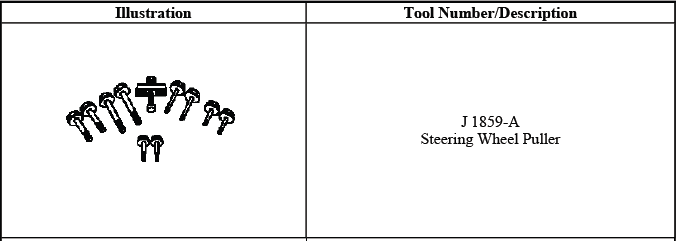
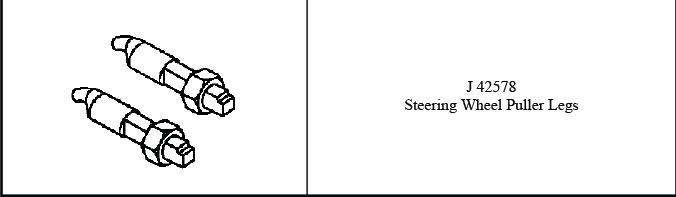
The following special tool references support steering wheel and steering column service. Always select the correct tool before removing column components, steering wheel parts, trim covers, switches, or related electrical connectors, because improper handling can damage retainers, sensor alignment, SIR-related parts, or steering column adjustment components.